
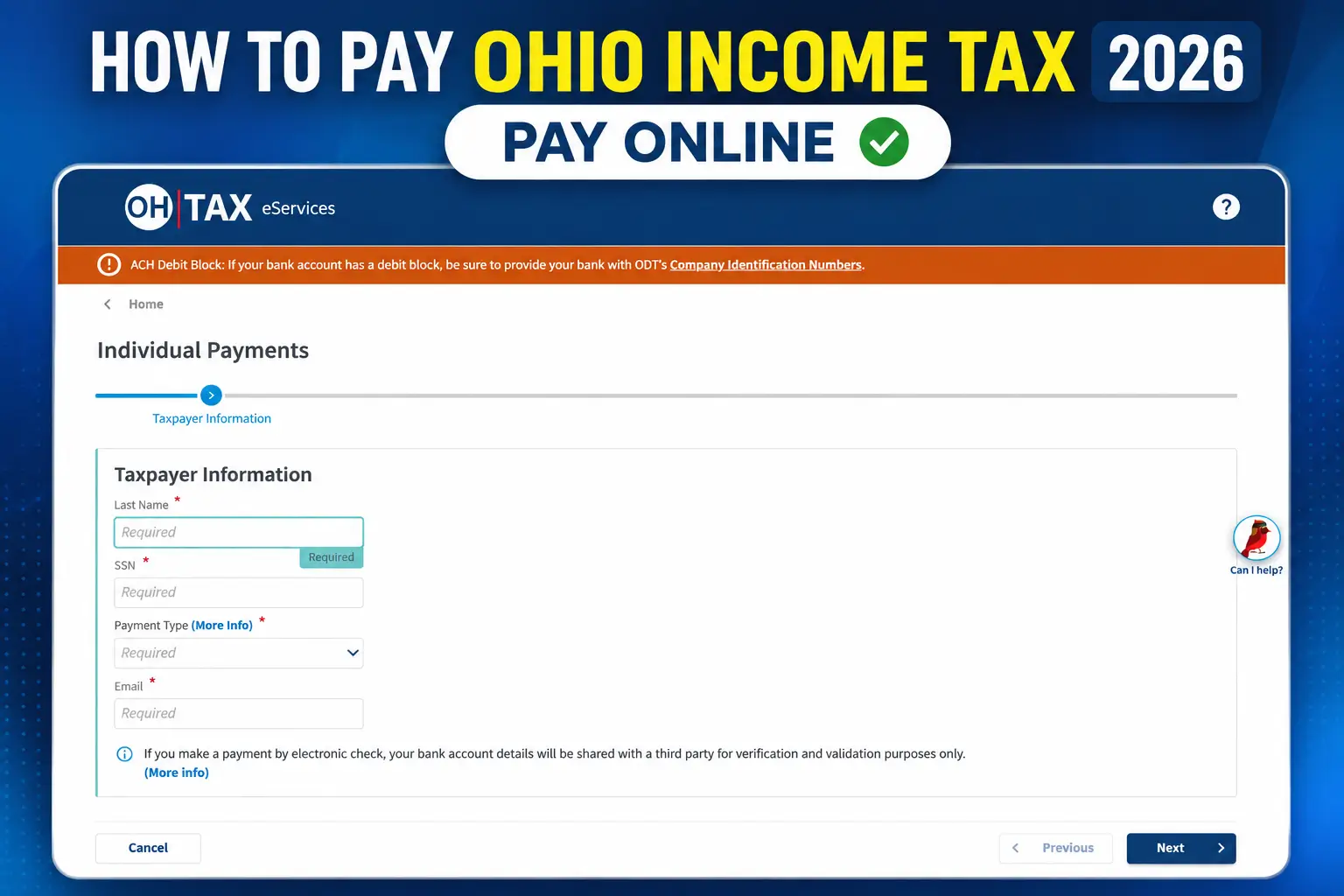
Quick Answer: To pay your 2026 Ohio income tax, use the Ohio Department of Taxation’s online portal, OH|TAX eServices, to pay directly from your bank account at no charge.
You can also pay by credit or debit card for a 2.5% fee, or mail a check. The 2026 tax is a flat 2.75% on taxable income above the $26,700 personal exemption. Most taxpayers must pay any tax due by April 15, 2027.
Direct Links
- OH|TAX eServices tax.ohio
- Pay Online – Individual and School District Income Taxestax.ohio
- Ohio tax formstax.ohio
- Ohio tax help centertax.ohio
Ohio’s 2026 Income Tax System at a Glance
What Changed? The 2026 Flat Tax Transition
For tax year 2026, Ohio completed its multi‑year transition to a single flat tax rate. House Bill 33 eliminated the previous graduated bracket system. The final change simplifies tax planning: all taxable income is now taxed at the same rate, regardless of total earnings.
The 2026 Tax Rate & Personal Exemption
- Flat rate: 2.75% on all Ohio taxable income above the personal exemption.
- Personal exemption: $26,700 for every filing status. The exemption is indexed annually for inflation and applies before the tax rate is calculated.
This means a single filer with $40,000 of Ohio adjusted gross income pays tax on only $13,300—the amount exceeding $26,700.
How Ohio’s Flat Tax Compares to Previous Years
In 2025, Ohio used a two‑bracket structure: 2.75% on income between $26,050 and $100,000, and 3.5% above $100,000. The flat tax eliminates the higher bracket entirely, providing a modest reduction for higher‑income taxpayers while keeping the effective rate unchanged for most.
Learn More in Our Complete Guide:
Do You Need to Pay Ohio Income Tax?
Who Is Considered an Ohio Resident for Tax Purposes
Ohio defines a resident as someone domiciled in the state or who maintains a permanent place of abode and spends more than 183 days of the year in Ohio. Residents are taxed on all income, regardless of where it is earned.
A nonresident is taxed only on Ohio‑source income, such as wages for services performed in Ohio or rental income from Ohio property. Ohio has no reciprocity agreements with other states, so a nonresident earning Ohio wages must file.
Filing Requirements: Income Thresholds & Special Cases
You generally must file a 2026 Ohio income tax return if your Ohio adjusted gross income exceeds the $26,700 personal exemption. However, even if income is below the threshold, you may need to file if:
- You are a nonresident with Ohio‑source income.
- You are a part‑year resident.
- You are claiming a refundable credit (such as the earned income credit).
- You made estimated payments and want a refund.
Nonresidents, Part‑Year Residents & Remote Workers
Remote workers present a common point of confusion. If you live outside Ohio and perform all work from your home state, your wages are not Ohio‑source income, even if your employer is based in Ohio. Conversely, an Ohio resident who works remotely for an out‑of‑state company must still report all wages as Ohio income. Part‑year residents who moved into or out of Ohio during 2026 must file Form IT 1040 along with Schedule IT NRC to allocate income between periods of residency.
How Your Ohio Tax Liability Is Determined
What Counts as Ohio Taxable Income
Ohio taxable income begins with federal adjusted gross income, then applies Ohio‑specific adjustments. The most common adjustments add back certain municipal bond interest from other states and deduct income from U.S. government obligations. After adjustments, the personal exemption of $26,700 is subtracted to arrive at Ohio taxable income.
Adjustments, Deductions & Credits That Reduce Your Bill
- Retirement income credit: Taxpayers age 65 and older may qualify for a credit of up to $50 per return if income is below the phase‑out threshold.
- Joint filer credit: A small credit may apply to married couples filing jointly.
- School district tax: Some Ohio residents owe a separate school district income tax, but this does not change your state tax calculation.
Step‑by‑Step Example: Calculating Tax for a Typical Filer
Maria, single, age 40, has a federal AGI of $55,000 and no Ohio adjustments.
- Ohio adjusted gross income: $55,000
- Subtract personal exemption: $55,000 – $26,700 = $28,300
- Apply flat rate: $28,300 × 2.75% = $778.25
Maria’s Ohio tax liability before payments and credits is $778.25.
Key Takeaway: Because of the generous personal exemption, a significant portion of income is shielded from Ohio tax entirely.
Step‑by‑Step Payment Methods for 2026
Paying Online Through OH|TAX eServices
The Ohio Department of Taxation’s OH|TAX eServices portal is the preferred payment method for its speed, security, and no‑fee ACH debit option. To pay:
- Visit tax.ohio.gov and select “OH|TAX eServices.”
- Log in or create an account using your Social Security number and prior‑year AGI.
- Choose “Make a Payment” and select the tax year 2026.
- Enter your bank routing and account number for ACH debit, or choose credit card.
- Review the payment summary and submit. Print or save the confirmation number.
Paying by Credit Card, ACH Debit, or Check
| Method | Fee | Processing Time | Best For | |
|---|---|---|---|---|
| ACH debit (OH | TAX) | Free | 1–2 business days | Most taxpayers |
| Credit/debit card | 2.5% of amount ($2.00 min) | Instant | Those who want to pay immediately or earn rewards | |
| Check or money order | Free | 7–10 days for mail delivery and processing | Taxpayers who prefer paper records |
When mailing a check, include the Ohio IT 1040 payment voucher and write your Social Security number and “2026 IT 1040” on the memo line. Do not send cash.
Making Quarterly Estimated Tax Payments
Self‑employed individuals, freelancers, and others with more than $500 in annual Ohio tax liability after withholding must make quarterly estimated payments using Form IT 1040ES. Estimated payments are due on April 15, June 16, September 15, 2026, and January 15, 2027. You can pay online through OH|TAX or mail a voucher with a check. Failing to pay enough through withholding or estimates may result in an underpayment penalty.
Critical Deadlines, Penalties & Extensions
Key Filing & Payment Dates for 2026
- April 15, 2027: Annual return (Form IT 1040) and full payment due.
- Quarterly estimated taxes: April 15, June 16, September 15, 2026; January 15, 2027.
- Extension to file: Submit Form IT 40P by April 15, 2027, to extend the filing deadline to October 15, 2027.
Important: An extension to file is not an extension to pay. Tax not paid by April 15 accrues interest and penalties even if you file later.
Late Payment Penalties & Interest – How They Are Calculated
- Late payment penalty: 5% of the unpaid tax per month, capped at 50% of the unpaid amount.
- Interest: Charged at the federal short‑term rate plus 5%, applied from the original due date until the tax is paid in full.
For example, if you owe $1,000 and pay 30 days late, the penalty alone is $50, plus daily interest. Paying as close to the due date as possible minimizes these charges.
How to Request an Extension or Payment Plan
File Form IT 40P electronically or by mail to obtain an automatic six‑month filing extension. If you cannot pay the full amount, the Ohio Department of Taxation allows installment agreements in many cases. Contact the ODT collections division or apply through your OH|TAX account to request a payment plan before the due date.
Special Situations & Advanced Payment Scenarios
Self‑Employed & Independent Contractors
Freelancers must pay Ohio tax on net self‑employment income. Because no employer withholds, quarterly estimated payments are mandatory. Use the Ohio estimated tax worksheet (included in the IT 1040ES instructions) to calculate your required installments.
Retirees, Military Personnel & Pass‑Through Entity Tax
- Retirees: Ohio does not tax Social Security benefits. Retirement income from pensions may be partially or fully taxed depending on your age and the type of plan.
- Military: Active‑duty service members who are not Ohio residents are not taxed on military pay, even if stationed in Ohio.
- Pass‑through entity tax (PTET): Owners of S corporations and partnerships may elect to pay a composite Ohio tax through the entity using Form IT 1140. This can simplify filing for nonresident owners.
Local Tax Interactions: Municipal & School District Income Taxes
Many Ohio cities and some school districts levy their own income taxes, filed separately from the state return. Municipal taxes are generally administered by the Regional Income Tax Agency (RITA) or the Central Collection Agency (CCA). Check with your city of residence or work to determine your local filing requirement.
Common Payment Mistakes & How to Avoid Them
Errors That Trigger Penalties, Interest, or Rejected Payments
- Using the wrong tax year: Always select “2026” when making an online payment.
- Incorrect bank account numbers: Double‑check routing and account numbers; a rejected ACH payment may result in late penalties.
- Forgetting to sign or include the payment voucher: Paper returns without signatures or vouchers are considered incomplete.
- Paying the wrong agency: Send Ohio state payments to the Ohio Department of Taxation, not the IRS or your local tax office.
How to Confirm Your Payment Was Received & Track Your Refund
After an online payment, you receive a confirmation number immediately. Store this number safely. To check the status of a refund or confirm a payment has been processed, log into OH|TAX eServices and select “View Payments” or “Where’s My Refund?” Refunds from e‑filed returns are typically issued within 15 days; paper returns may take 8 weeks or longer.
Real‑World Scenario & How CPA Advice Corrects It
Jordan, a remote worker living in Indiana, had Ohio tax withheld from his pay because his employer is located in Columbus. A CPA review of his situation revealed he is a nonresident performing no services in Ohio. He filed an Ohio nonresident return to claim a full refund of the withheld tax and adjusted his employer’s withholding.
This illustrates why understanding residency rules can prevent unnecessary tax payments.
Next Steps & Additional Resources
Official Forms, Portals & Contact Information
- OH|TAX eServices: tax.ohio.gov
- Form IT 1040 and instructions: Available at tax.ohio.gov/forms
- Ohio Department of Taxation taxpayer assistance: 1-800-282-1780
Related Guides on ohiotaxguide.com
- Ohio Residency Rules for Tax Purposes
- Ohio Estimated Tax Payments Guide
- Ohio Municipal Income Tax: What You Must Know
Downloadable Ohio Tax Payment Checklist
A one‑page checklist summarizing the steps to pay your 2026 Ohio income tax is available for download. It includes payment method comparisons, key dates, and a confirmation tracker.
Frequently Asked Questions
Do I have to pay Ohio income tax if I live out of state but work in Ohio?
Yes. Nonresidents are taxed on income for services performed in Ohio.
Can I pay my Ohio tax with a credit card?
Yes, through ACI Payments, Inc., with a 2.5% convenience fee.
When is the 2026 Ohio tax return due?
April 15, 2027, unless an extension is requested.
How do I pay estimated taxes?
Use OH|TAX eServices or mail Form IT 1040ES with a check. Quarterly deadlines apply.
What happens if I miss a payment?
A 5% per month penalty plus interest will be assessed on the unpaid amount.
Is my Social Security taxed in Ohio?
No. Ohio does not tax Social Security benefits.
For specific advice, consult a qualified tax professional.