
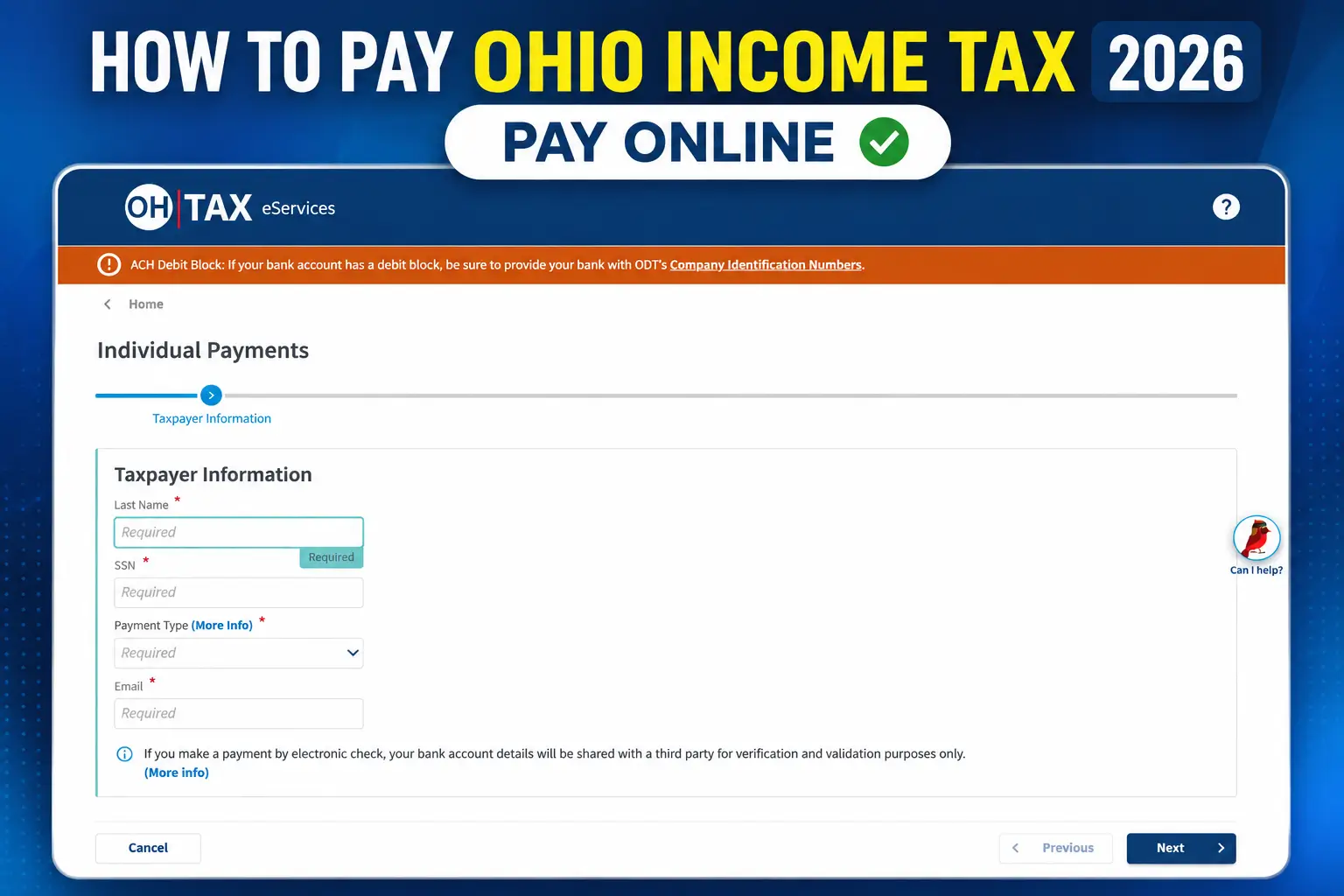
Pay your 2026 Ohio income tax online through OH|TAX eServices or the Guest Payment Service at tax.ohio.gov/pay. Bank-account (ACH) payments are free, while credit or debit cards cost a 2.65% fee. You can also pay by phone or mail a check with the Ohio Universal Payment Coupon (OUPC).
For 2026, Ohio charges no tax on the first $26,050 of Ohio taxable income. Above that, the tax is $332 plus 2.75% of the amount over $26,050, and any tax you owe is due by April 15, 2027.
Direct Links
- OH|TAX eServices tax.ohio
- Pay Online – Individual and School District Income Taxestax.ohio
- Ohio tax formstax.ohio
- Ohio tax help centertax.ohio
Ohio’s 2026 Income Tax System at a Glance
What Changed? The 2026 Flat Tax Transition
For tax year 2026, Ohio completed its multi-year transition to a single flat tax rate. House Bill 96 (signed June 2025) collapsed the previous graduated brackets into one rate: no tax on the first $26,050 of Ohio taxable income, then $332 plus 2.75% of the amount over $26,050. The change simplifies tax planning: all taxable income above the threshold is now taxed at the same rate, regardless of total earnings.
The 2026 Tax Rate & Personal Exemption
- Flat rate: 2.75% on Ohio taxable income above $26,050, plus a $332 base amount once income passes that threshold. There is no higher bracket in 2026.
- Personal exemption: a separate per-person amount — $2,400, $2,150, or $1,850 depending on your modified adjusted gross income ($40,000 or less / $40,001–$80,000 / over $80,000), and $0 if your modified AGI is $500,000 or more. You claim one exemption for yourself, one for your spouse, and one for each dependent. The exemption is subtracted from your Ohio adjusted gross income before the tax table is applied.
This means a single filer with $40,000 of Ohio adjusted gross income and a $2,400 exemption has $37,600 of Ohio taxable income — and owes $332 plus 2.75% of the $11,550 above $26,050, or about $650.
How Ohio’s Flat Tax Compares to Previous Years
In 2025, Ohio used a two-rate structure: 2.75% on income between $26,050 and $100,000, and 3.125% above $100,000. The 2026 flat tax eliminates the higher bracket entirely, providing a modest reduction for higher-income taxpayers while keeping the effective rate unchanged for most. (The 3.5% top rate belonged to 2024, not 2025.)
Learn More in Our Complete Guide:
Do You Need to Pay Ohio Income Tax?
Who Is Considered an Ohio Resident for Tax Purposes
Ohio defines a resident as someone domiciled in the state or who maintains a permanent place of abode and spends more than 183 days of the year in Ohio. Residents are taxed on all income, regardless of where it is earned.
A nonresident is taxed only on Ohio-source income, such as wages for services performed in Ohio or rental income from Ohio property. Ohio does have reciprocity agreements — with five states: Indiana, Kentucky, Michigan, Pennsylvania, and West Virginia.
If you live in one of those states and your only Ohio-source income is wages, you do not owe Ohio tax on those wages and generally do not need to file an Ohio return for them; file Form IT-4 with your employer so Ohio tax is not withheld. Reciprocity does not cover city income tax, or business, rental, or gambling income. See our full guide to Ohio’s five reciprocal agreements.
Filing Requirements: Income Thresholds & Special Cases
You generally must file a 2026 Ohio income tax return if your Ohio adjusted gross income is more than your total personal exemption amount. For a single filer that amount is only a few thousand dollars, so most people with Ohio income must file — but you do not have to file if your exemption amount covers your Ohio adjusted gross income, or if your Ohio adjusted gross income is $0 or less. However, even if income is below the threshold, you may need to file if:
- You are a nonresident with Ohio‑source income.
- You are a part‑year resident.
- You are claiming a refundable credit (such as the earned income credit).
- You made estimated payments and want a refund.
Nonresidents, Part‑Year Residents & Remote Workers
Remote workers present a common point of confusion. If you live outside Ohio and perform all work from your home state, your wages are not Ohio‑source income, even if your employer is based in Ohio. Conversely, an Ohio resident who works remotely for an out‑of‑state company must still report all wages as Ohio income. Part‑year residents who moved into or out of Ohio during 2026 must file Form IT 1040 along with Schedule IT NRC to allocate income between periods of residency.
How Your Ohio Tax Liability Is Determined
What Counts as Ohio Taxable Income
Ohio taxable income begins with federal adjusted gross income, then applies Ohio-specific adjustments. The most common adjustments add back certain municipal bond interest from other states and deduct income from U.S. government obligations. After adjustments, your personal exemption — $2,400, $2,150, or $1,850 per person depending on income — is subtracted to arrive at Ohio taxable income.
Adjustments, Deductions & Credits That Reduce Your Bill
- Retirement income credit: up to $200 per return, tiered by how much retirement income you received ($25 to $200; over $8,000 of retirement income earns the full $200). Your modified AGI minus exemptions must be under $100,000. Separately, a $50 senior citizen credit applies if you are 65 or older, under the same $100,000 test. (R.C. 5747.055)
- Joint filer credit: married couples filing jointly, where each spouse has at least $500 of qualifying income, get a credit of 20%, 15%, 10% or 5% of their tax — the percentage falls as income rises — capped at $650, and only if modified AGI is under $500,000. (R.C. 5747.05)
- School district tax: Some Ohio residents owe a separate school district income tax, but this does not change your state tax calculation.
Step‑by‑Step Example: Calculating Tax for a Typical Filer
Maria, single, age 40, has a federal AGI of $55,000 and no Ohio adjustments.
- Ohio adjusted gross income: $55,000. Her modified AGI of $55,000 puts her personal exemption at $2,150 (the $40,001–$80,000 tier).
- Subtract personal exemption: $55,000 – $2,150 = $52,850 of Ohio taxable income.
- Apply the 2026 tax table: $332 + 2.75% × ($52,850 – $26,050) = $332 + $737.00 = $1,069.00. Maria’s Ohio tax liability before payments and credits is $1,069.00.
Key Takeaway: The first $26,050 of Ohio taxable income is taxed at 0%, so lower earners owe nothing — but the personal exemption itself is only a couple of thousand dollars, not the whole $26,050.
Step‑by‑Step Payment Methods for 2026
Paying Online Through OH|TAX eServices
The Ohio Department of Taxation’s OH|TAX eServices portal is the preferred payment method for its speed, security, and no‑fee ACH debit option. To pay:
- Visit tax.ohio.gov and select “OH|TAX eServices.”
- Log in or create an account using your Social Security number and prior‑year AGI.
- Choose “Make a Payment” and select the tax year 2026.
- Enter your bank routing and account number for ACH debit, or choose credit card.
- Review the payment summary and submit. Print or save the confirmation number.
Can’t Log In to OH|TAX eServices? Portal Login Help
Most login problems with Ohio’s tax portal come down to using the wrong account. OH|TAX eServices signs you in with OHID — Ohio’s single sign-in for state services. Your OHID username and password are the same ones you use for the Ohio Business Gateway and the Online Notice Response Service, so if you already have an OHID from another Ohio service, use that account instead of creating a new one.
First time logging in? Create an OHID account first. You will need your Social Security number and your prior-year adjusted gross income to register, so have last year’s Ohio return handy.
Forgot your username or password? Use the “Forgot username” or “Forgot password” link on the OHID sign-in page. The reset link goes to the email address on your OHID account, so check your inbox (and spam folder) for it.
Still locked out? Call the Ohio Department of Taxation’s individual taxpayer assistance line at 1-800-282-1780 and have your Social Security number and prior-year return nearby. Do not share your password with anyone, and never sign in through a link in an email — always go to tax.ohio.gov directly.
Paying a business tax? Do not use OH|TAX eServices. Business taxes — including the Commercial Activity Tax, sales tax, and employer withholding — are paid through the Ohio Business Gateway. OH|TAX eServices covers individual income tax and school district income tax only.
If you can log in but your payment is not showing, check that you selected the right tax year (2026) and the right tax type before paying. Our Ohio tax transcript guide explains how to pull up to 10 years of your filed returns from the same OH|TAX account once you are in.
Paying Without an Account: Guest Payment Service
If you do not want an OHID account, use the Guest Payment Service at tax.ohio.gov/pay. Enter your Social Security number, the tax year and the payment type, then pay by bank account for free or by card for the 2.65% fee. Guest payments cannot be scheduled for a future date, and you cannot view past payments.
Paying by Phone
Call 1-800-272-9829 (1-800-2PAY-TAX) to pay by credit or debit card through ACI Payments, Inc. Have your Social Security number, the tax year and your card ready. The same 2.65% fee applies, and you get a confirmation number at the end of the call.
Paying by Credit Card, ACH Debit, or Check
| Method | Fee | Processing Time | Best For | |
|---|---|---|---|---|
| ACH debit (OH | TAX) | Free | 1–2 business days | Most taxpayers |
| Credit/debit card | 2.65% of amount ($1.00 min) | Instant | Those who want to pay immediately or earn rewards | |
| Check or money order | Free | 7–10 days for mail delivery and processing | Taxpayers who prefer paper records |
On a $1,000 payment, the card fee is $26.50. The same payment from your bank account costs $0. Electronic-check payments can be scheduled for a future date up to the due date. Card payments are charged the day you authorise them and cannot be future-dated.
To pay by mail, send a check or money order payable to ‘Ohio Treasurer of State’ with the Ohio Universal Payment Coupon (OUPC) to: Ohio Department of Taxation, PO Box 182131, Columbus, OH 43218-2131. Write your Social Security number and ‘2026 IT 1040’ on the memo line. Do not send cash. Mail at least a week before the due date — allow 7 to 10 days for delivery and processing.
Making Quarterly Estimated Tax Payments
Self‑employed individuals, freelancers, and others with more than $500 in annual Ohio tax liability after withholding must make quarterly estimated payments using Form IT 1040ES. Estimated payments are due on April 15, June 15, September 15, 2026, and January 15, 2027. You can pay online through OH|TAX or mail a voucher with a check. Failing to pay enough through withholding or estimates may result in an underpayment penalty.
Critical Deadlines, Penalties & Extensions
Key Filing & Payment Dates for 2026
- April 15, 2027: Annual return (Form IT 1040) and full payment due.
- Quarterly estimated taxes: April 15, June 15, September 15, 2026; January 15, 2027.
- Extension to file: Get a federal extension (IRS Form 4868) by April 15, 2027. Ohio automatically extends your filing deadline to October 15, 2027 — there is no separate Ohio extension form. When you file, check the federal-extension box on Form IT 1040 and attach a copy of your federal extension.
Important: An extension to file is not an extension to pay. Tax not paid by April 15 accrues interest and penalties even if you file later.
Late Payment Penalties & Interest – How They Are Calculated
- Late-payment penalty: up to twice the interest charged on the unpaid tax (R.C. 5747.15(A)(2)). For 2026 the interest rate is 7% a year, so the penalty is at most 14% of the unpaid tax — a one-off amount, not a monthly charge.
- Interest: 7% a year for 2026 under R.C. 5703.47 (ODT’s certified rate), charged from the original due date until the tax is paid in full. Do not use the 9% figure you may see for city income tax — that is the municipal rate under R.C. 718.27 (federal short-term rate plus 5 points), not the state rate.
- Late-filing penalty (separate): if you file late, the penalty is the greater of $50 per month or 5% of the tax due per month, capped at $500 or 50% of the tax due (R.C. 5747.15(A)(1)).
For example, if you owe $1,000 and pay 30 days late, the interest is about $5.75 and the late-payment penalty is at most about $11.51 — roughly $17 in total, not $50-plus. Paying as close to the due date as possible still minimises these charges.
Sources: R.C. 5747.15, R.C. 5703.47, ODT Annual Certified Interest Rates. Our Tax Liens guide states the same figures.
How to Request an Extension or Payment Plan
If you cannot pay the full amount, the Ohio Department of Taxation allows installment agreements in many cases. To pay the tax you expect to owe by April 15, use OH|TAX eServices, the Guest Payment Service, or mail a check with an OUPC.
Special Situations & Advanced Payment Scenarios
Self‑Employed & Independent Contractors
Freelancers must pay Ohio tax on net self‑employment income. Because no employer withholds, quarterly estimated payments are mandatory. Use the Ohio estimated tax worksheet (included in the IT 1040ES instructions) to calculate your required installments.
Retirees, Military Personnel & Pass‑Through Entity Tax
- Retirees: Ohio does not tax Social Security benefits. Retirement income from pensions may be partially or fully taxed depending on your age and the type of plan.
- Military: Active‑duty service members who are not Ohio residents are not taxed on military pay, even if stationed in Ohio.
- Pass‑through entity tax (PTET): Owners of S corporations and partnerships may elect to pay a composite Ohio tax through the entity using Form IT 1140. This can simplify filing for nonresident owners.
Local Tax Interactions: Municipal & School District Income Taxes
Many Ohio cities and some school districts levy their own income taxes, filed separately from the state return. Municipal taxes are generally administered by the Regional Income Tax Agency (RITA) or the Central Collection Agency (CCA). Check with your city of residence or work to determine your local filing requirement.
Common Payment Mistakes & How to Avoid Them
Errors That Trigger Penalties, Interest, or Rejected Payments
- Using the wrong tax year: Always select “2026” when making an online payment.
- Incorrect bank account numbers: Double‑check routing and account numbers; a rejected ACH payment may result in late penalties.
- Forgetting to sign or include the payment voucher: Paper returns without signatures or vouchers are considered incomplete.
- Paying the wrong agency: Send Ohio state payments to the Ohio Department of Taxation, not the IRS or your local tax office.
How to Confirm Your Payment Was Received & Track Your Refund
After an online payment, you receive a confirmation number immediately. Store this number safely. To check the status of a refund or confirm a payment has been processed, log into OH|TAX eServices and select “View Payments” or “Where’s My Refund?”
Refunds from e-filed returns with direct deposit are typically issued within 15 business days. E-filed returns paid by paper check take about 22 business days, and paper returns take 8 to 10 weeks.
Real‑World Scenario & How CPA Advice Corrects It
Jordan, a remote worker living in Indiana, had Ohio tax withheld from his pay because his employer is located in Columbus. A CPA review of his situation revealed he is a nonresident performing no services in Ohio. He filed an Ohio nonresident return to claim a full refund of the withheld tax and adjusted his employer’s withholding.
This illustrates why understanding residency rules can prevent unnecessary tax payments.
Next Steps & Additional Resources
Official Forms, Portals & Contact Information
- OH|TAX eServices: tax.ohio.gov
- Form IT 1040 and instructions: Available at tax.ohio.gov/forms
- Ohio Department of Taxation taxpayer assistance: 1-800-282-1780
Related Guides on ohiotaxguide.com
- Ohio Residency Rules for Tax Purposes
- Ohio Estimated Tax Payments Guide
- Ohio Municipal Income Tax: What You Must Know
Ohio Tax Payment Checklist
- Work out your 2026 Ohio tax: $332 plus 2.75% of taxable income over $26,050.
- Choose how to pay: free bank-account payment online, card (2.65% fee), phone, or check by mail with an OUPC.
- Check you selected tax year 2026 and the right tax type before you pay.
- Save your confirmation number (online and phone payments) or a copy of your mailed check and OUPC.
- Pay by April 15, 2027 — an extension to file is not an extension to pay.
- Track your refund with the Check My Refund Status tool on tax.ohio.gov.
Frequently Asked Questions
Do I have to pay Ohio income tax if I live out of state but work in Ohio?
Yes. Nonresidents are taxed on income for services performed in Ohio.
Can I pay my Ohio tax with a credit card?
Yes, through ACI Payments, Inc., with a 2.65% convenience fee ($1 minimum).
When is the 2026 Ohio tax return due?
April 15, 2027, unless an extension is requested.
How do I pay estimated taxes?
Use OH|TAX eServices or mail Form IT 1040ES with a check. Quarterly deadlines apply.
What happens if I miss a payment? Interest of 7% a year for 2026 plus a late-payment penalty of up to twice the interest charged will be assessed on the unpaid amount — roughly $17 on a $1,000 payment 30 days late, not $50-plus.
Is my Social Security taxed in Ohio?
No. Ohio does not tax Social Security benefits.
Do I need an account to pay online?
No. The Guest Payment Service at tax.ohio.gov/pay lets you pay without an OHID account. An OH|TAX eServices account adds payment history and future-dated payments.
How do I get more time to file?
File a federal extension (IRS Form 4868). Ohio automatically extends your filing deadline to October 15, 2027. Your payment is still due April 15, 2027.
For specific advice, consult a qualified tax professional.
5 thoughts on “How to Pay Ohio Income Tax 2026: Step‑by‑Step Guide”