
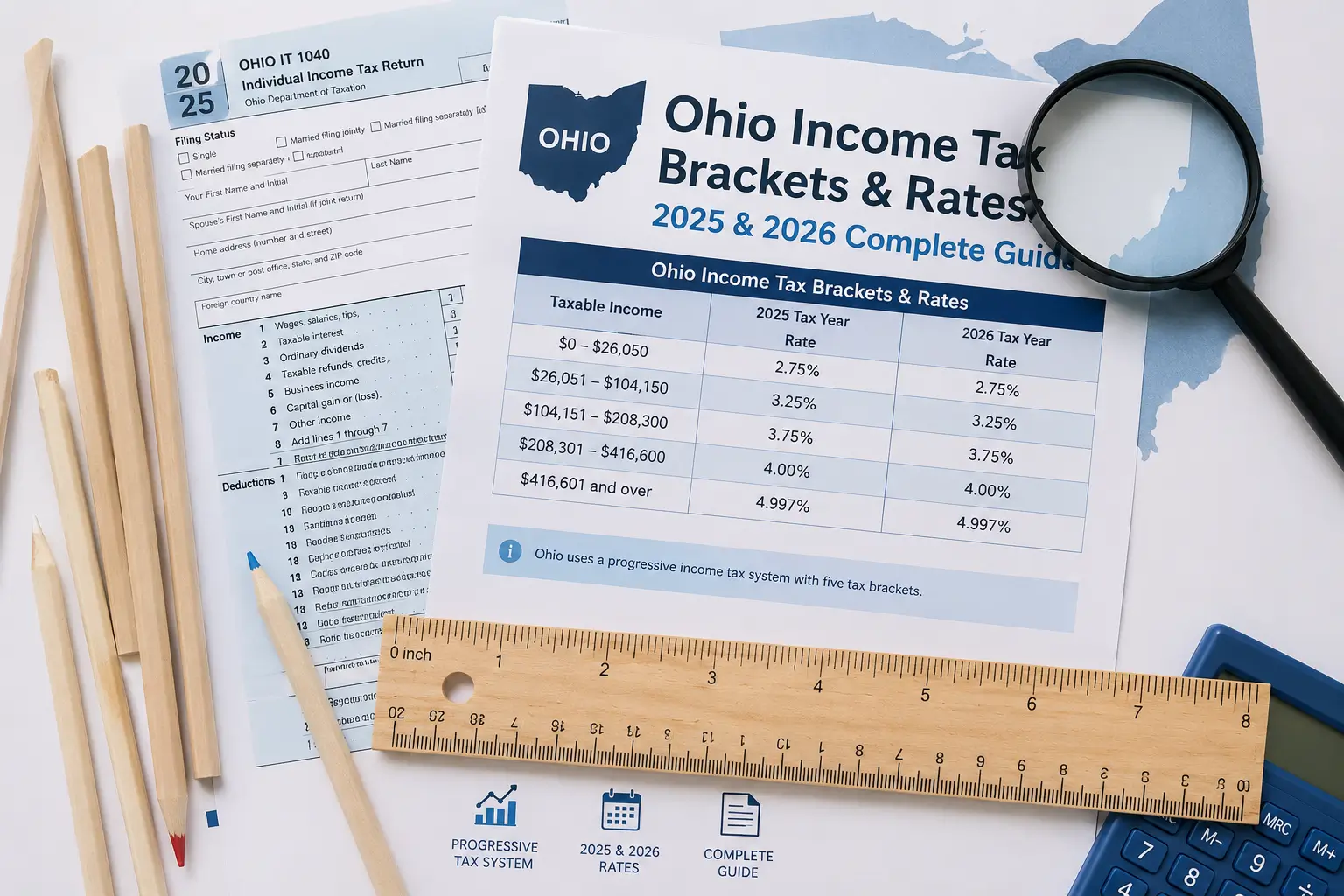
Quick Answer: For 2025, Ohio’s brackets are 0% on $0–$26,050, 2.75% on $26,051–$100,000, and 3.125% above $100,000. For 2026, Ohio switches to a flat 2.75% on all income above $26,050, eliminating the top bracket. The first $26,050 stays tax-free in both years thanks to the personal exemption credit.
Fact-checked and verified against Ohio Revised Code § 5747.02 and official Ohio Department of Taxation publications.
What Are Ohio’s Income Tax Rates for 2025?
For tax year 2025, Ohio has three tax rates: 0% on the first $26,050 of taxable income, 2.75% on income between $26,051 and $100,000, and 3.125% on income over $100,000. [1]
For 2026 and beyond, Ohio transitions to a flat tax: 2.75% on all taxable income over $26,050. The first $26,050 of taxable income is not taxed in both 2025 and 2026. [2]
This guide explains Ohio’s income tax rates, filing requirements, residency rules, and how to calculate your tax liability. You’ll also learn about important deadlines, available credits and deductions, and what the 2026 flat tax means for you.
Ohio Income Tax Overview
Ohio’s personal income tax is a state-level tax on earned income, administered by the Ohio Department of Taxation (ODT). The tax applies to individuals residing in Ohio, as well as nonresidents earning income from Ohio sources.
House Bill 96, effective September 30, 2025, introduced significant reforms to Ohio’s personal income tax system, transitioning from a graduated rate structure to a flat tax for most taxpayers beginning in 2026. [3]
| Tax Year | Structure | Rates |
|---|---|---|
| 2024 | Graduated | 0% / 2.75% / 3.5% |
| 2025 | Graduated | 0% / 2.75% / 3.125% |
| 2026+ | Flat | 0% / 2.75% |
Source: Ohio Revised Code § 5747.02(A)(3)
Why This Matters: The 2025 top rate reduction from 3.5% to 3.125% saves taxpayers about $375 for every $100,000 of taxable income over the threshold. The 2026 flat tax eliminates the top bracket entirely, simplifying calculations for all Ohio taxpayers.
2025 Ohio Income Tax Brackets
For taxable year 2025 (returns filed in 2026), Ohio’s tax rates on taxable nonbusiness income are as follows:
| Taxable Income | Tax Rate | Tax Calculation |
|---|---|---|
| $0 – $26,050 | 0% | $0 |
| $26,051 – $100,000 | 2.75% | $342 + 2.75% of amount over $26,050 |
| Over $100,000 | 3.125% | $2,394.32 + 3.125% of amount over $100,000 |
Source: Ohio Revised Code § 5747.02(A)(3)(b)
Important: These rates apply to “taxable nonbusiness income” — primarily income from wages, salaries, and most work. Business income is taxed differently and may qualify for the Business Income Deduction (see below).
Example: Calculating 2025 Ohio Tax
Scenario: You are a single Ohio resident with $60,000 in taxable nonbusiness income.
| Step | Calculation | Amount |
|---|---|---|
| 1. Taxable income | — | $60,000 |
| 2. First $26,050 taxed at 0% | $26,050 × 0% | $0 |
| 3. Remaining $33,950 taxed at 2.75% | $33,950 × 2.75% | $933.63 |
| 4. Total tax | — | $933.63 |
Scenario: You are a single Ohio resident with $125,000 in taxable nonbusiness income.
| Step | Calculation | Amount |
|---|---|---|
| 1. Taxable income | — | $125,000 |
| 2. Tax on first $100,000 | $342 + 2.75% × ($100,000 − $26,050) | $2,394.32 |
| 3. Tax on remaining $25,000 at 3.125% | $25,000 × 3.125% | $781.25 |
| 4. Total tax | — | $3,175.57 |
2026 Ohio Flat Tax (House Bill 96)
Beginning January 1, 2026, Ohio transitions to a flat personal income tax rate of 2.75% on all taxable income over $26,050.
| Taxable Income | Tax Rate | Tax Calculation |
|---|---|---|
| $0 – $26,050 | 0% | $0 |
| Over $26,050 | 2.75% | $332 + 2.75% of amount over $26,050 |
Source: Ohio Revised Code § 5747.02(A)(3)(c)
Key Change: The flat tax eliminates the 3.125% top bracket, simplifying the tax structure for all Ohio taxpayers.
2024 vs 2025 vs 2026 Comparison
| Bracket | 2024 Rate | 2025 Rate | 2026+ Rate |
|---|---|---|---|
| Up to $26,050 | 0% | 0% | 0% |
| $26,051 – $100,000 | 2.75% | 2.75% | 2.75% (flat) |
| Over $100,000 | 3.5% | 3.125% | 2.75% (flat) |
What the Flat Tax Means for You
- If you earn under $100,000: No change from 2025 rates
- If you earn over $100,000: Your top rate drops from 3.125% to 2.75%
- Simplification: No need to calculate multiple bracket tiers
CPA Insight: The flat tax eliminates the need for complex bracket calculations. For high earners, this represents a meaningful tax reduction — approximately $375 less tax for every $100,000 of income over the threshold compared to 2025.
For Complete Detail Check Our Guide:
Who Must File an Ohio Income Tax Return?
Ohio residents with a positive federal adjusted gross income generally must file an Ohio income tax return (Form IT 1040).
Filing Requirements
You must file an Ohio IT 1040 if you are:
- An Ohio resident with positive Ohio adjusted gross income (Ohio AGI)
- A part-year resident with Ohio income during your residency period
- A nonresident earning income from Ohio sources (wages, business income, lottery winnings, etc.)
Filing Threshold
If your Ohio adjusted gross income is $0 or less, you are not required to file.
Important: Even if you owe no tax, you may need to file to claim a refund of taxes withheld or to report school district income tax liability.
Check Our Detailed Guide on Who Must File Ohio Taxes:
Who Must File Ohio Income Tax in 2026? (Filing Rules)
Ohio Residency Rules for Tax Purposes
Resident
You are considered an Ohio resident if you are domiciled in Ohio — meaning Ohio is your permanent home. Ohio residents are taxed on all income, regardless of where it is earned.
Part-Year Resident
If you moved into or out of Ohio during the tax year, you are a part-year resident. You are taxed on income earned while an Ohio resident. Part-year residents are also considered residents of a school district during their time in Ohio.
Nonresident
Nonresidents are taxed only on Ohio-source income, including:
- Wages earned from Ohio employers
- Lottery, casino, and sports gaming winnings
- Ohio property income
- Pass-through entity income from Ohio businesses
Common Mistake: Assuming you don’t need to file if you live outside Ohio but work remotely for an Ohio employer. If your employer withholds Ohio tax, you may need to file a nonresident return to claim a refund.
How to Calculate Your Ohio Income Tax
Step 1: Calculate Ohio Adjusted Gross Income (AGI)
Start with your federal AGI. Make Ohio-specific adjustments using the Schedule of Adjustments:
- Additions: Certain income not taxed federally but taxed by Ohio
- Subtractions: Certain income taxed federally but not taxed by Ohio
Step 2: Apply Deductions and Exemptions
Ohio does not have a standard deduction.However, you may claim:
- Personal exemptions for yourself, spouse, and dependents (as provided in R.C. 5747.025)
- Pregnancy center deduction: Lesser of $750 or donated amount (up to $1,500 for joint filers)
- Ohio educator expense deduction: $300 per qualifying Ohio educator
- Business income deduction: Up to $250,000 for single/MFJ filers; $125,000 for MFS
Note: Inflation indexing for income tax brackets and personal exemption amounts is suspended for tax years 2025 and 2026.
Step 3: Apply Tax Brackets
After subtracting deductions and exemptions, apply the appropriate rate schedule (2025 or 2026) to your taxable income.
Step 4: Subtract Tax Credits
Tax credits reduce your tax dollar-for-dollar. Available credits include:
- Joint filer income tax credit (subject to MAGI limits: $750,000 for 2025; $500,000 for 2026)
- Home school expense credit: $250 per qualifying student (changed from $250 per return)
- Senior citizen credit: $50
- Transformational mixed-use development credit (certificate-based, carryforward up to 5 years)
Must Read Detailed Guide About: Ohio Tax Credits & Deductions (2026)
Ohio Forms: IT 1040 and Supporting Schedules
Form IT 1040 — Ohio Individual Income Tax Return
The Ohio IT 1040 is the primary tax return for individuals. It includes:
| Schedule | Purpose |
|---|---|
| Schedule of Adjustments | Ohio-specific AGI adjustments |
| Schedule of Business Income | Business income and deduction |
| Schedule of Credits | Tax credits claimed |
| Schedule of Dependents | Dependent information |
| IT WH | Ohio withholding reported |
| OUPC | Unified payment coupon |
Source: Ohio Department of Taxation
For a complete breakdown of Ohio tax forms, filing requirements, revision dates, and supporting schedules, see our Ohio Tax Forms 2026 Guide.
Form SD 100 — School District Income Tax Return
If you lived in a taxing school district, you must file Form SD 100 in addition to your IT 1040. As of January 2026, 210 Ohio school districts have an income tax.
Important: You may have a school district income tax liability even if you do not have an Ohio income tax liability. In such cases, you must file both an SD 100 and an IT 1040.
Other Forms
| Form | Purpose |
|---|---|
| IT 10 | Zero liability / no refund |
| IT 4738 | Electing pass-through entity income tax return |
| IT 1041 | Fiduciary income tax return |
Where to Get Forms
- Online: https://tax.ohio.gov/home/forms
- Phone: 1-800-282-1782 (24-hour form request line)
- Online request: OH|TAX eServices portal
Filing Deadlines and Important Dates
| Date | Event |
|---|---|
| January 26, 2026 | Filing season opens |
| April 15, 2026 | Filing deadline for IT 1040 and SD 100 |
| April 15, 2026 | All tax payments due |
| October 15, 2026 | Extension filing deadline |
Source: Ohio Department of Taxation
Warning: Ohio does not have an extension request form but honors the IRS extension. However, extension to file is NOT extension to pay — all tax payments are due by April 15, 2026.
Estimated Tax Payment Deadlines
| Quarter | Due Date |
|---|---|
| 1st Quarter | April 15, 2026 |
| 2nd Quarter | June 15, 2026 |
| 3rd Quarter | September 15, 2026 |
| 4th Quarter | January 15, 2027 |
If any due date falls on a weekend or holiday, the due date becomes the next business day.
Filing and Payment Methods
Filing Methods
E-file (Recommended):
- Faster processing
- Fewer errors
- Direct deposit available
- Available through OH|TAX eServices
Paper Filing:
- Mail to Ohio Department of Taxation
- Slower processing (allow 6-8 weeks for refunds)
- Higher error rates
Tip: The Ohio Department of Taxation recommends filing your return as soon as you have all the necessary information. If you are due a refund, filing early allows you to receive it sooner.
Payment Methods
- OH|TAX eServices: Online payments
- Check or money order: Mail with payment coupon (OUPC)
- Credit card: Available through OH|TAX eServices
Estimated Tax Payments
You must make estimated tax payments if your Ohio tax liability (tax minus credits and withholding) exceeds $500.
Common Mistake: Missing estimated payment deadlines can result in the 2210 interest penalty.
Employer Withholding
Every employer maintaining an office or transacting business in Ohio must withhold Ohio income tax from employee compensation. Employers must register within 15 days of when withholding liability begins.
Withholding Exceptions:
- Residents of Michigan, Indiana, Kentucky, West Virginia, or Pennsylvania earning wages in Ohio are exempt from Ohio withholding
- Nonresident civilian spouses of military servicemembers stationed in Ohio.
Penalties and Interest
| Penalty Type | Amount | Maximum |
|---|---|---|
| Late filing | $50 per month | $500 |
| Late payment | Double the interest amount | — |
Source: Ohio Department of Taxation
Warning: Penalties and interest accrue from the original due date, even if you have a filing extension.
How to Avoid Penalties
- File on time — even if you can’t pay in full
- Pay as much as possible by April 15
- Request a payment plan if needed
- Verify your return is complete and accurate before submission
Special Circumstances
Remote Workers
Nonresidents with Ohio-source income must file an Ohio IT 1040. Ohio taxes nonresidents on wages earned from Ohio employers or services performed in Ohio.
Scenario: You live in Indiana but work remotely for an Ohio-based company. Your employer withholds Ohio tax. You should file a nonresident Ohio return to report your Ohio-source income and claim any withholding credit.
Military Personnel
- Nonresident servicemembers: Military income is not taxed by Ohio, regardless of where earned
- Resident servicemembers: Can deduct active duty military pay received while stationed outside Ohio
- Spouses: May elect to use the servicemember’s state of residence for tax purposes
Part-Year Residents
If you moved into or out of Ohio during the year, file a part-year resident return. Ohio uses your total income to determine the rate, then applies it to Ohio-only income.
Retirees
- Social Security benefits: Fully exempt from Ohio tax
- Retirement income credit: Available if MAGI less exemptions is under $100,000
- Senior citizen credit: $50 for taxpayers 65 or older
Self-Employed Individuals
- File Schedule of Business Income with your IT 1040
- Claim Business Income Deduction (up to $250,000 single/MFJ; $125,000 MFS)
- Make estimated tax payments if liability minus withholding exceeds $500
Ohio Local Taxes: Municipal and School District
School District Income Tax
The Ohio school district income tax is separate from state income tax. As of January 2026, 210 Ohio school districts have an income tax.
Key Points:
- You pay based on where you live, not where you work
- Part-year residents are residents of a school district during their time in Ohio
- File Form SD 100 if you lived in a taxing school district
- Use The Finder at tax.ohio.gov/finder to find your district and rate
Common Mistake: Forgetting to file SD 100. You may have a school district tax liability even if you don’t owe Ohio income tax.
Municipal Income Tax
Many Ohio cities and villages levy their own income tax, typically 0.5% to 3%. These taxes are administered by:
- RITA (Regional Income Tax Agency) — administers taxes for many municipalities
- CCA (Central Collection Agency) — administers taxes for some municipalities
- Municipalities — some cities administer their own taxes
Note: Municipal income tax is separate from state and school district taxes. You must file separate returns for each.
Ohio Tax Credits and Deductions Summary
| Credit/Deduction | Amount | Eligibility |
|---|---|---|
| Home school expense credit | $250 per qualifying student | Home-schooled students in Ohio |
| Senior citizen credit | $50 | Taxpayers 65 or older |
| Joint filer credit | Varies | Subject to MAGI limits |
| Pregnancy center deduction | Lesser of $750 or donated amount | Joint filers up to $1,500 total |
| Ohio educator expense deduction | $300 per qualifying educator | K-12 educators working 900+ hours |
| Business income deduction | Up to $250,000 (single/MFJ) | Business income earners |
Source: Ohio Department of Taxation, “What’s New” for tax year 2025
Common Filing Mistakes to Avoid
- Confusing tax year with filing year — File 2025 taxes in 2026
- Forgetting school district tax — Check if you lived in a taxing district
- Incorrect residency classification — Verify your residency status
- Missing estimated payment deadlines — Payments due quarterly
- Assuming no tax = no filing requirement — You may need to file to claim refunds
- Confusing extension to file with extension to pay — Payments due April 15
- Entering incorrect SSN or taxpayer ID — Verify all personal information
- Omitting income — Report all income, including secondary sources
Official Ohio Tax Resources
| Resource | Contact/URL |
|---|---|
| Ohio Department of Taxation | tax.ohio.gov |
| OH|TAX eServices | myportal.tax.ohio.gov/tap |
| Refund Status | 1-800-282-1784 |
| General Information | 1-800-282-1780 |
| Form Requests | 1-800-282-1782 |
| Forms Online | tax.ohio.gov/forms |
| The Finder (School District) | tax.ohio.gov/finder |
| Ohio Revised Code | codes.ohio.gov |
Frequently Asked Questions
What are Ohio’s 2025 income tax brackets?
Ohio’s 2025 tax rates are 0% on income up to $26,050, 2.75% on income between $26,051 and $100,000, and 3.125% on income over $100,000.
What is the Ohio flat tax rate for 2026?
The flat tax rate for 2026 and beyond is 2.75% on all taxable income over $26,050.
Who must file Ohio income taxes?
Ohio residents with positive federal AGI, part-year residents with Ohio income, and nonresidents with Ohio-source income must file.
When are Ohio taxes due?
The filing deadline for 2025 Ohio taxes is April 15, 2026.
Does Ohio have a standard deduction?
No. Ohio does not have a standard deduction. Instead, taxpayers may claim personal exemptions and itemized deductions.
How do I check my Ohio refund status?
Call 1-800-282-1784 or check online through OH|TAX eServices.
How are remote workers taxed in Ohio?
Nonresidents with Ohio-source income (including wages from Ohio employers) must file an Ohio return.
What is the penalty for filing Ohio taxes late?
The late filing penalty is $50 per month, up to a maximum of $500.
Do I have to pay estimated taxes?
You must make estimated tax payments if your Ohio tax liability minus credits and withholding exceeds $500.
Are Social Security benefits taxed in Ohio?
No. Social Security benefits are fully exempt from Ohio income tax.
How does Ohio’s 2026 flat tax work?
For tax year 2026 and later, Ohio applies a single flat rate of 2.75% to all taxable income above $26,050. The first $26,050 is not taxed, thanks to the personal exemption credit. The flat tax eliminates the old 3.125% top bracket and the need to calculate multiple tiers.
Can you show a worked example of the 2026 flat tax?
Take a single filer with $60,000 of Ohio taxable income. Subtract the $26,050 zero bracket: $60,000 − $26,050 = $33,950. Multiply by the flat rate: $33,950 × 2.75% = $933.63. Total Ohio tax: $933.63.
What is Ohio’s personal exemption and how does it create the $26,050 zero bracket?
Ohio’s personal exemption credit effectively shields the first $26,050 of taxable income from tax in both 2025 and 2026. You calculate tax only on income above that threshold.
How does Ohio withholding change under the 2026 flat tax?
Employers withhold Ohio income tax from wages based on state tables. With a single flat rate of 2.75% above $26,050, withholding calculations become simpler. If too much is withheld, you claim the difference as a refund when you file.
How are part-year residents taxed in Ohio?
If you moved into or out of Ohio during the year, you file as a part-year resident and are taxed on income earned while an Ohio resident (plus any Ohio-source income). The $26,050 zero bracket and 2.75% flat rate apply to your Ohio taxable income.
Do I still need to file if my income is under $26,050?
If your Ohio adjusted gross income is $26,050 or less, you generally owe no Ohio income tax. However, you may still want to file to claim a refund of any tax withheld or to report school district income tax.
Last updated: 30 September 2026
Disclaimer: This guide is for informational purposes only and does not constitute legal or tax advice. Tax laws change frequently. Consult a qualified tax professional for advice specific to your situation. All tax rates and deadlines should be verified against official Ohio Department of Taxation publications before filing.
6 thoughts on “Ohio Income Tax Brackets: 2025 & 2026 Complete Guide”