
Calculate Your Ohio Sales Tax in Seconds
Enter your county and purchase amount to see the exact tax, fast, free and in plain English.
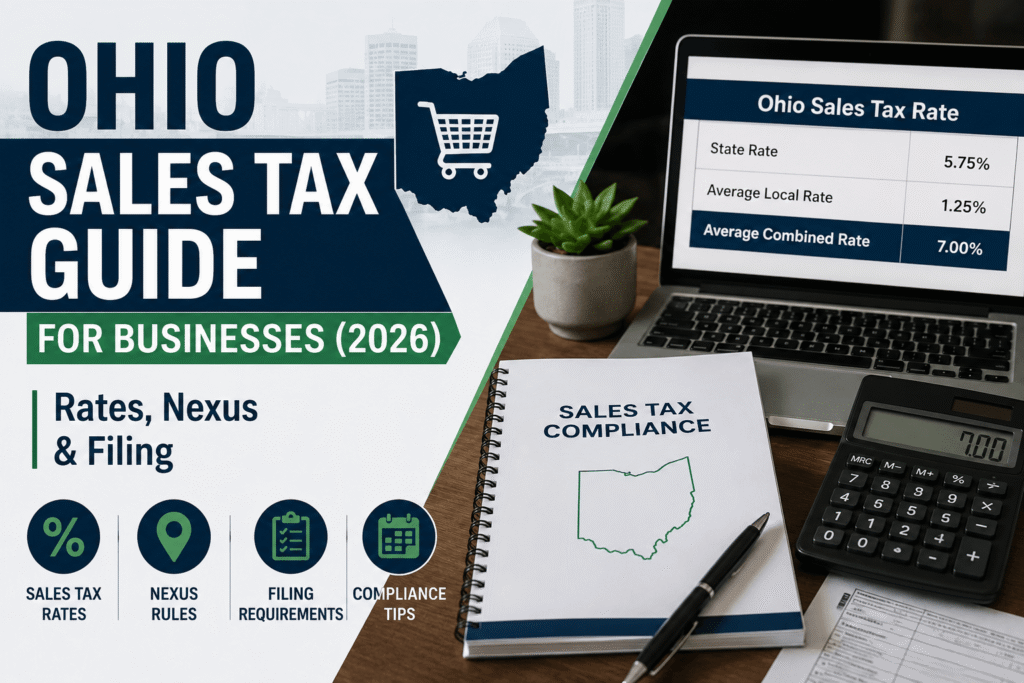
Ohio imposes a 5.75% state sales tax on retail sales of tangible personal property and certain services, with local counties and transit authorities adding 0.75% to 2.25% in additional taxes.
Combined rates range from 5.75% to 8.75% depending on the delivery location, as Ohio uses destination-based sourcing—the rate is determined by where the customer takes possession, not where your business is located.
Understanding Ohio’s sales tax system is essential for any business selling goods or taxable services in the state. Whether you operate a brick-and-mortar store in Columbus, run an e-commerce business shipping to Ohio customers, or provide software-as-a-service (SaaS) to Ohio-based clients, you need to know when to register, what rates to charge, which items are taxable, and how to file returns correctly.
This guide walks you through every aspect of Ohio sales tax compliance—from determining whether you have nexus to filing your returns and claiming the vendor’s discount. The information is current as of July 2026 and reflects recent legislative changes, including the vendor discount cap effective January 1, 2026.
What Is Ohio Sales Tax and How Does It Work?
What is sales tax?
Sales tax is a transaction-based tax imposed on retail sales of tangible personal property and certain services in Ohio.Under Ohio law, the consumer is legally responsible for paying the tax, but the vendor acts as a trustee who collects the tax from the customer and remits it to the state.This means your business serves as an agent of the state of Ohio when you collect sales tax—you are not paying the tax yourself; you are collecting it on behalf of the government.
Important: Many business owners mistakenly believe they are paying the sales tax. In reality, you are collecting it from customers and remitting it to the state—you are a tax collector, not a taxpayer, for sales tax purposes.
How does Ohio sales tax work?
Ohio uses destination-based sourcing for most sales.This means you charge the sales tax rate applicable to the location where the customer receives the product or service, not the rate where your business is located. For example, if your business is in Cleveland but you ship a product to a customer in Columbus, you charge the Columbus rate (Franklin County’s combined rate), not the Cuyahoga County rate.
Ohio’s sales tax applies to:
- Tangible personal property (physical goods)
- Certain specified services (enumerated in the Ohio Revised Code)
- Digital goods and software (including SaaS in many cases)
Who administers Ohio sales tax?
The Ohio Department of Taxation administers and enforces Ohio’s sales and use tax laws.The legal framework is established in Ohio Revised Code (ORC) Chapter 5739 (Sales Tax) and Chapter 5741 (Use Tax).Counties and regional transit authorities may levy additional local taxes, which are collected alongside the state tax.
Do You Need to Collect Ohio Sales Tax? (Nexus Guide)
Before you register for a vendor’s license, you must determine whether your business has sufficient connection to Ohio—known as nexus—to create an obligation to collect and remit sales tax.
What is sales tax nexus?
Nexus is the legal connection between your business and a state that requires you to collect and remit sales tax. In Ohio, nexus can be established through physical presence or economic activity.
Physical nexus in Ohio
You have physical nexus in Ohio if your business has any of the following in the state:
- A store, office, or other place of business
- A warehouse or inventory
- Employees or sales representatives
- Tangible personal property
If you have physical nexus, you must register for an Ohio vendor’s license regardless of your sales volume.
Economic nexus in Ohio
Even without a physical presence, you may have economic nexus if you meet either of the following thresholds in the current or preceding calendar year:
| Threshold | Requirement |
|---|---|
| Gross sales into Ohio | $100,000 or more |
| Separate transactions into Ohio | 200 or more |
Warning: If you exceed either threshold, you are required to register, collect, and remit Ohio sales tax—even if you have no physical presence in the state. This applies to out-of-state sellers, e-commerce businesses, and marketplace sellers.
Economic nexus became effective in Ohio on August 1, 2019.
Marketplace facilitator rules
Ohio requires marketplace facilitators (such as Amazon, eBay, and Etsy) to collect and remit sales tax on behalf of third-party sellers in many cases.If you sell through a marketplace that already collects Ohio sales tax, you may not need to register separately for those sales. However, if you also make direct sales outside the marketplace, you must track your total Ohio sales (including marketplace sales) toward the economic nexus threshold.
CPA Tip: Many out-of-state sellers incorrectly assume they have no nexus because they lack a physical presence. If you exceed $100,000 in Ohio sales or 200 transactions, you must register regardless of where you’re located. And remember—marketplace sales count toward your threshold.
Ohio Sales Tax Rates: State, Local, and Combined
Ohio state sales tax rate
The Ohio state sales tax rate is 5.75%. This rate has been in effect since 1934 and applies uniformly across the state.
Local option taxes by county and city
Counties and regional transit authorities in Ohio may levy additional sales taxes in multiples of 0.05% up to a combined maximum of 3%.The total combined rate—state, county, and transit authority—may not exceed 8.75%.
Local rates typically range from 0.75% to 2.25%,with the average combined state and local rate around 7.1% to 7.3%.
| Location | County | Combined Rate (Est.) |
|---|---|---|
| Columbus | Franklin | ~7.50% |
| Cincinnati | Hamilton | ~7.80% |
| Cleveland | Cuyahoga | ~8.00% |
| Toledo | Lucas | ~7.75% |
| Akron | Summit | ~6.75% |
| Dayton | Montgomery | ~7.50% |
Note: Rates vary by exact location within each county. Always verify the specific rate for your customer’s delivery address.
How to calculate the correct combined rate
Because Ohio uses destination-based sourcing, you must apply the rate for the location where the customer receives the goods or services.The combined rate is:
State rate (5.75%) + County rate + Transit authority rate = Combined rate
For example, if you sell to a customer in a county with a 1.25% local rate, the combined rate would be 7.00%.
Ohio sales tax rate lookup tools
To find the correct rate for any Ohio address:
- Use the Ohio Department of Taxation’s online rate lookup tool
- Consult the department’s current rate tables
- Use reputable third-party rate calculators from Avalara, TaxJar, or Stripe
What Items and Services Are Taxable in Ohio?
Tangible personal property
Most tangible personal property—physical goods—is taxable in Ohio.This includes:
- Furniture and appliances
- Electronics and computers
- Clothing and footwear
- Motor vehicles
- Building materials
- Office supplies
Taxable services in Ohio
Unlike many states, Ohio taxes only specifically enumerated services rather than all services generally.Taxable services under ORC § 5739.01(B) include:
| Service Category | Examples |
|---|---|
| Motor vehicle services | Washing, waxing, polishing, painting |
| Laundry and dry cleaning | Garment cleaning services |
| Automatic data processing | Computer services, data processing |
| Building maintenance | Janitorial services |
| Snow removal | If annual sales exceed $5,000 |
| Telecommunications | Phone, internet, and related services |
| Recreation and sports clubs | Membership fees |
CPA Tip: Ohio generally does not tax professional services (legal, accounting, consulting) or personal services (haircuts, massages). However, if you provide a service that is specifically listed in ORC § 5739.01(B), you must collect tax.
Digital products and SaaS
Ohio considers digital goods and software taxable in most cases.This includes:
- Software as a Service (SaaS)
- Digital downloads (music, e-books, software)
- Streaming services
- Cloud-based applications
If you sell SaaS or digital products to Ohio customers, you generally must collect sales tax.
Special categories: food, vehicles, and more
| Category | Taxable? | Notes |
|---|---|---|
| Groceries (unprepared) | Exempt | Food for home consumption |
| Prepared food (restaurants) | Taxable | Meals, prepared food items |
| Prescription drugs | Exempt | Prescription medications |
| Over-the-counter drugs | Taxable | Non-prescription medications |
| Motor vehicles | Taxable | Subject to specific rules |
| Newspapers | Exempt | Printed newspapers |
Ohio Sales Tax Exemptions: What Is Not Taxable?
Common Ohio sales tax exemptions
Several categories of purchases are exempt from Ohio sales tax under ORC § 5739.02:
| Exemption Category | Description |
|---|---|
| Groceries | Unprepared food for home consumption |
| Prescription drugs | Medications prescribed by a licensed professional |
| Prosthetic devices | Medical devices and equipment |
| Newspapers | Printed news publications |
| Sales to government | Federal, state, and local government purchases |
| Manufacturing inputs | Machinery and equipment used directly in manufacturing (with certificate) |
| Resale items | Goods purchased for resale (with certificate) |
How to claim an exemption
To claim an exemption, the purchaser must provide the vendor with a properly completed exemption certificate at the time of purchase.The vendor is relieved of liability for collecting tax if they obtain a fully completed certificate.
Exemption certificates: STEC B and STEC U
Ohio provides two primary exemption certificate forms:
| Form | Name | Use Case |
|---|---|---|
| STEC B | Sales and Use Tax Blanket Exemption Certificate | Recurring exemptions from a specific vendor (multiple purchases) |
| STEC U | Sales and Use Tax Unit Exemption Certificate | Single, one-time purchase exemption |
Warning: An exemption certificate does not expire in Ohio, but you must update it if your business information changes. Auditors will request these certificates—keep them organized and readily accessible.
How to Register for an Ohio Sales Tax Permit
Who needs to register?
Any business with physical nexus or economic nexus in Ohio must register for a vendor’s license before making taxable sales.
Step-by-step registration process
In-state sellers (physical presence):
- Complete Form ST-1 (Application for Vendor’s License to Make Taxable Sales)
- Submit the application to your county auditor or online through OH|TAX eServices
- Pay the required license fee
- Receive your vendor’s license and filing frequency assignment
Out-of-state/remote sellers (economic nexus):
- Complete Form UT-1000 (Application for Out-of-State Sellers and/or Marketplace Facilitator Registration)
- Submit online through OH|TAX eServices
- No fee is required for remote seller registration
Registration fees and costs
| Seller Type | Form | Fee | Effective Date |
|---|---|---|---|
| In-state seller (physical presence) | ST-1 | $50 | April 9, 2025 |
| Remote seller (economic nexus) | UT-1000 | Free | Current |
Important: The in-state vendor license fee increased from $25 to $50 effective April 9, 2025, under House Bill 366.The additional $25 supports the Organized Crime Commission Fund.
Paper applications may take up to six weeks to process.Online applications through OH|TAX eServices are processed faster.
What to do after registration
After registration, you will:
- Receive a vendor’s license number
- Be assigned a filing frequency (monthly, quarterly, or semi-annual)
- Be required to file returns for every period, even if no tax is due
How to File and Pay Ohio Sales Tax
Ohio sales tax filing frequencies
The Ohio Department of Taxation assigns filing frequencies based on your expected tax liability:
| Frequency | Typical Criteria | Due Date |
|---|---|---|
| Monthly | Collections averaging over $200/month | 23rd of following month |
| Semi-annual | Collections averaging under $200/month | July 23 (Jan-Jun), January 23 (Jul-Dec) |
Some sources also reference quarterly filing, but Ohio primarily uses monthly and semi-annual frequencies.
You must file a return for every active period, even if you made no sales and owe no tax.
Ohio sales tax deadlines
All Ohio sales tax returns are due by the 23rd day of the month following the reporting period under ORC § 5739.12(A).
| Reporting Period | Due Date |
|---|---|
| Monthly (January) | February 23 |
| Monthly (February) | March 23 |
| Monthly (March) | April 23 |
| Monthly (April) | May 23 |
| Monthly (May) | June 23 |
| Monthly (June) | July 23 |
| Monthly (July) | August 23 |
| Monthly (August) | September 23 |
| Monthly (September) | October 23 |
| Monthly (October) | November 23 |
| Monthly (November) | December 23 |
| Monthly (December) | January 23 |
| Semi-annual (Jan-Jun) | July 23 |
| Semi-annual (Jul-Dec) | January 23 |
Warning: If the 23rd falls on a weekend or state holiday, the deadline moves to the next business day.
How to file online (OH|TAX eServices)
Ohio requires electronic filing for most businesses. File through OH|TAX eServices, the state’s online tax portal.The primary return form is the UST-1 (Universal Sales Tax Return).
Ohio sales tax payment methods
| Payment Method | Details | |
|---|---|---|
| **OH | TAX eServices** | Online payment via ACH debit or credit card |
| Check or money order with paper return | ||
| In-person | At county auditor’s office (limited) |
The vendor’s discount: how to claim it
Ohio offers a vendor’s discount of 0.75% (three-fourths of one percent) of the tax due for vendors who file on time and pay the full amount due.
Key details:
- Discount rate: 0.75%
- Monthly cap (effective January 1, 2026): $750 per vendor’s license, per return period
- Applies only if the UST-1 return and full payment are received by the due date
- Cap does not apply to sales or leases of motor vehicles
Example: If your monthly tax liability is $200,000, the calculated discount would be $1,500 (0.75% of $200,000). However, with the $750 cap per vendor’s license, you would receive only $750 if you have one license.
CPA Tip: The vendor’s discount is essentially free money for filing on time. Don’t leave it on the table. If you have multiple vendor’s licenses, each license is eligible for up to $750 per month—but note that the cap applies per license, not per return.
Understanding Ohio Use Tax for Businesses
What is Ohio use tax?
Use tax is a complementary tax to sales tax, imposed at the same rate as sales tax (5.75% state plus local taxes).It applies when taxable goods or services are purchased from out-of-state sellers who did not collect Ohio sales tax, and the items are used, stored, or consumed in Ohio.
When does use tax apply to businesses?
Common use tax scenarios for businesses include:
How to calculate and pay Ohio use tax
Use tax is calculated at the same rate as sales tax (state + local rate where the item is used).
To pay use tax:
- Complete the Universal Use Tax Return (UUT-1) or use the Voluntary Payment of Use Tax (VP USE) form
- Remit payment to the Ohio Department of Taxation
- Consumers may also remit use tax on their personal income tax return (Form IT-1040)
Common use tax mistakes and how to avoid them
Warning: Use tax is the most commonly overlooked tax by Ohio businesses. If you buy equipment, supplies, or inventory from an out-of-state vendor who didn’t charge Ohio tax, you owe use tax—and the state is aware these transactions occur.
Common mistakes:
- Assuming no tax is owed if the seller didn’t charge tax
- Failing to track out-of-state purchases
- Not understanding that use tax applies even if the seller has no nexus
- Confusing sales tax (collected from customers) with use tax (owed on purchases)
CPA Tip: Keep a separate account for tracking out-of-state purchases. Many businesses set up a use tax accrual account to ensure funds are available when returns are due.
Ohio Sales Tax Penalties, Interest, and Audit Defense
Ohio sales tax late filing penalties
Failing to file or pay on time triggers penalties under ORC § 5739.13 and § 5739.133:
| Violation | Penalty |
|---|---|
| Late filing | Penalty assessed under ORC § 5739.12(D) |
| Late payment | Penalty under ORC § 5739.13 |
| Maximum penalty | 50% of the amount assessed |
The penalty structure generally includes a minimum penalty of $50 or 10% (whichever is greater), with additional penalties for prolonged delays. Interest also accrues on unpaid amounts.
Ohio sales tax interest rates
Interest on unpaid sales tax is calculated under ORC § 5703.47, using the federal short-term rate (rounded to the nearest whole number) plus 3 percentage points.
| Year | Interest Rate |
|---|---|
| 2026 | 7% per annum |
| 2025 | 8% per annum |
| 2024 | 10% per annum |
CPA Tip: Interest accrues daily on unpaid amounts. If you cannot pay the full amount by the deadline, file your return on time (to avoid the late filing penalty) and pay what you can, then request a payment plan for the balance.
How to avoid penalties
- File on time—even if you cannot pay the full amount
- File zero returns if you had no taxable sales
- Request a penalty waiver if this is your first late filing—Ohio offers a one-time penalty waiver in many cases
- Set up a payment plan if you are unable to pay the full amount
What to do if you receive an audit notice
If the Ohio Department of Taxation notifies you of an audit:
- Respond promptly—do not ignore the notice
- Gather all records—exemption certificates, sales invoices, purchase records, and tax returns
- Consider professional representation—a CPA or tax attorney can guide you through the process
- Cooperate fully with the auditor
Ohio sales tax appeals process
If you disagree with an audit assessment, you have the right to appeal:
- File a petition for reassessment with the Tax Commissioner
- If denied, appeal to the Ohio Board of Tax Appeals
- Further appeal to the Ohio courts is available
Ohio Sales Tax Recordkeeping Requirements
What records must you keep?
You must maintain records that support your sales tax returns, including:
- Sales invoices and receipts
- Purchase records
- Exemption certificates (STEC B, STEC U)
- Tax returns filed
- Payment confirmations
How long to keep sales tax records
The statute of limitations for Ohio sales tax assessments is generally four years from the date the tax was due or paid.Keep all records for at least four years—preferably longer.
Best practices for recordkeeping
CPA Tip: The statute of limitations for Ohio sales tax assessments is generally four years. Keep all exemption certificates, invoices, and tax returns for at least four years—preferably longer to be safe.
Best practices:
- Maintain both digital and physical copies when possible
- Organize exemption certificates by vendor and date
- Keep records of all out-of-state purchases (for use tax purposes)
- Store records in a secure, accessible location
- Consider cloud-based recordkeeping for easy access during audits
Industry-Specific Ohio Sales Tax Guidance
Retail and e-commerce
- Most tangible goods are taxable
- Shipping and handling charges bundled with the sale are generally taxable
- Exemption certificates required for resale purchases
- Economic nexus applies to remote sales
SaaS and digital products
- SaaS and digital products are generally taxable in Ohio
- B2B sales may be exempt in certain circumstances
- Registration required if economic nexus threshold is met
CPA Tip: Ohio considers most software and digital services taxable. If you sell SaaS to Ohio customers, you likely need to collect sales tax unless a specific exemption applies.
Construction and contractors
- Contractors are generally considered the end users of materials
- Contractors pay sales tax on materials at the time of purchase
- Contractors do not typically collect sales tax from customers
- Special exemptions may apply for certain projects
Manufacturing
- Machinery and equipment used directly in manufacturing may be exempt
- Form STEC B is used to claim manufacturing exemptions
- Raw materials that become part of the finished product may be exempt
Restaurants and food service
- Prepared food and beverages are taxable
- Groceries (unprepared food) are exempt
- Delivery fees may be taxable in some cases
Frequently Asked Questions
What is the Ohio sales tax rate?
The Ohio state sales tax rate is 5.75%.Local counties and transit authorities add additional taxes, bringing the combined rate to between 5.75% and 8.75% depending on the location.
What is Ohio use tax?
Ohio use tax is a complementary tax to sales tax, imposed at the same rate on taxable items purchased from out-of-state sellers who did not collect Ohio sales tax.If you buy equipment, supplies, or other taxable items from an out-of-state vendor and use them in Ohio, you owe use tax.
What items are taxable in Ohio?
Most tangible personal property (physical goods) is taxable, along with specifically enumerated services such as motor vehicle services, laundry and dry cleaning, automatic data processing, and building maintenance.Digital goods and SaaS are also generally taxable.
What items are exempt from Ohio sales tax?
Groceries (unprepared food), prescription drugs, prosthetic devices, newspapers, and sales to government entities are exempt.Purchases for resale and manufacturing inputs may also be exempt with proper documentation.
Do I need to collect Ohio sales tax?
You must collect Ohio sales tax if you have physical nexus (office, warehouse, employees, or property in Ohio) OR economic nexus ($100,000+ in gross sales OR 200+ transactions into Ohio in the current or preceding calendar year).
What is the Ohio economic nexus threshold?
The economic nexus threshold is $100,000 in gross sales OR 200 separate transactions into Ohio in the current or preceding calendar year.
How do I register for a sales tax permit in Ohio?
In-state sellers complete Form ST-1 and pay a $50 fee.Remote sellers complete Form UT-1000 at no charge.Applications can be submitted online through OH|TAX eServices.
When are Ohio sales tax returns due?
Ohio sales tax returns are due by the 23rd day of the month following the reporting period under ORC § 5739.12(A).If the 23rd falls on a weekend or holiday, the deadline is the next business day.
What are the penalties for late Ohio sales tax?
Late filing and late payment penalties are assessed under ORC § 5739.13, with a maximum penalty of 50% of the amount assessed.Interest also accrues at the rate set by the Tax Commissioner under ORC § 5703.47.The 2026 interest rate is 7% per annum.
How long must I keep sales tax records in Ohio?
Keep all sales tax records—including invoices, exemption certificates, and tax returns—for at least four years from the date the tax was due or paid.
This guide is for informational purposes only and does not constitute tax advice. Tax laws, rates, and thresholds change frequently. Always consult the Ohio Department of Taxation (tax.ohio.gov) or a qualified tax professional for your specific situation. Rates and rules verified as of July 2026.