
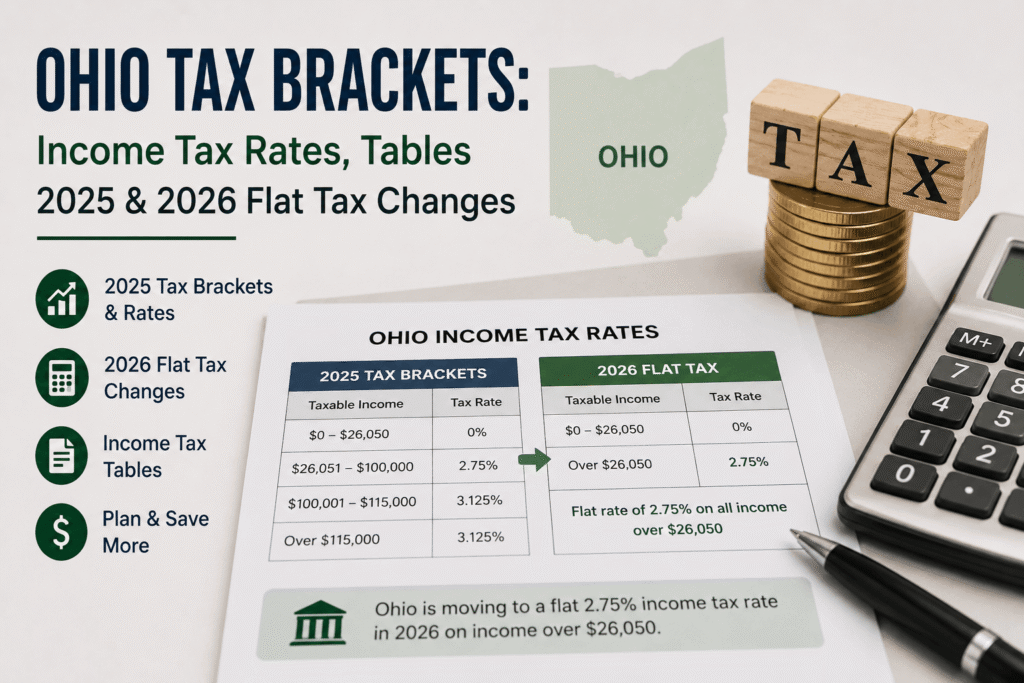
Ohio’s individual income tax is undergoing its most significant change in decades. For tax year 2025, the top rate drops to 3.125% on income over $100,000. For tax year 2026, Ohio transitions to a flat 2.75% tax on taxable income over $26,050 — simplifying filing and potentially lowering your tax bill.
This guide covers 2025 tax brackets, the 2026 flat tax transition, filing requirements, residency rules, payment options, and step-by-step filing instructions. All rates and thresholds are sourced directly from the Ohio Revised Code § 5747.02 and the Ohio Department of Taxation.
Key Takeaways
- 2025 rates: 0% up to $26,050; 2.75% on $26,051–$100,000; 3.125% over $100,000
- 2026 change: Flat 2.75% tax on taxable income over $26,050 with a $332 base tax
- Filing threshold: $26,050 of Ohio adjusted gross income
- Filing deadline: April 15, 2026 (Form IT 1040)
- Business income: Taxed separately at 3% with a $250,000 deduction
What Is Ohio Income Tax?
Ohio’s individual income tax is an annual tax imposed on the nonbusiness income of individuals who reside in or earn income from Ohio. The tax is administered by the Ohio Department of Taxation and governed by the Ohio Revised Code.
Overview of Ohio’s Individual Income Tax
Ohio imposes a tax on the nonbusiness income of residents, part-year residents, and nonresidents with Ohio-source income. Nonbusiness income includes wages, salaries, and investment earnings — but not business profits, which are taxed separately at a different rate.
The Ohio Department of Taxation administers the tax, processes returns, and issues refunds. Taxpayers file annually using Form IT 1040, the Ohio Individual Income Tax Return.
What Income Is Taxable in Ohio?
Ohio taxes nonbusiness income — your wages, salaries, and investment income — after applying exemptions and deductions. Business income is taxed separately at 3% with a $250,000 deduction ($125,000 for married filing separately).
For most taxpayers, this means their paycheck, retirement distributions, and investment earnings are subject to Ohio tax, while business profits may qualify for the separate business income rate.
A Brief History of Ohio’s Income Tax Rates
Ohio has gradually reduced its income tax rates over the past 20 years. The 2025–2026 changes continue this trend toward a simpler, flatter system. In 2024, the top rate was 3.5%. For 2025, the top rate drops to 3.125%. For 2026, the graduated structure is eliminated entirely in favor of a flat 2.75% rate.
Who Must File an Ohio Income Tax Return?
Determining whether you must file an Ohio income tax return is the first step in the filing process. The answer depends on your income level, residency status, and whether you have school district tax liability.
Ohio’s $26,050 Filing Threshold
If your Ohio adjusted gross income (after exemptions) is $26,050 or less, you owe no Ohio income tax. However, you may still need to file to claim refunds or credits.
Important: If your Ohio adjusted gross income is $26,050 or less, you owe no Ohio income tax. However, you may still need to file to claim refunds or credits.
Who Is Required to File
You must file an Ohio income tax return if you are an Ohio resident, part-year resident, or nonresident with Ohio-source income, and your Ohio adjusted gross income exceeds $26,050. Taxpayers with school district income tax liability must also file, regardless of their state tax liability.
The filing requirement applies to:
- Ohio residents: All income is taxable, regardless of where it was earned
- Part-year residents: Income earned while an Ohio resident, plus Ohio-source income earned as a nonresident
- Nonresidents: Only income from Ohio sources
Do I Need to File If I Owe No Tax?
Even if you owe no tax, filing may be required to claim refunds or credits. Some taxpayers file a zero-liability return (Form IT 10) to document their status.
CPA Tip: Filing a return even when no tax is due can protect your refund rights and establish compliance history.
Ohio Residency Rules: Are You a Resident?
Your residency status determines what income Ohio can tax. Correctly classifying your residency is essential to filing accurately and avoiding penalties.
What Is Domicile?
Domicile is your permanent legal residence — the place you intend to return to when absent. For Ohio tax purposes, a “resident” is an individual domiciled in Ohio. Your domicile is determined by factors including where you live, work, vote, and maintain your primary personal and financial connections.
Statutory Residency and the 213-Day Rule
Ohio law presumes you are domiciled in Ohio if you spend 213 or more “contact periods” (overnight stays) in the state during the tax year. You may rebut this presumption with clear and convincing evidence showing your domicile is outside Ohio.
The 213-day rule creates a statutory presumption of residency. If you spend 213 or more days in Ohio, the burden shifts to you to prove you are not an Ohio resident.
Nonresidents and Part-Year Residents
Nonresidents pay Ohio tax only on income from Ohio sources. Ohio-source income includes wages earned in Ohio, income from Ohio businesses, and rental income from Ohio property.
Part-year residents must allocate income between the period they were an Ohio resident and the period they were not. Income earned while an Ohio resident is fully taxable; income earned while a nonresident is taxable only if from Ohio sources.
2025 Ohio Tax Brackets
For tax year 2025, Ohio uses a graduated income tax with three rates. The top rate was reduced from 3.5% to 3.125% as part of the transition to a flat tax system.
2025 Ohio Tax Rates
For tax year 2025, Ohio imposes the following rates on taxable nonbusiness income:
Table 1: 2025 Ohio Income Tax Brackets
| Taxable Income | Tax Rate | Tax Owed |
|---|---|---|
| $0 – $26,050 | 0% | $0 |
| $26,051 – $100,000 | 2.75% | $342 + 2.75% of excess over $26,050 |
| Over $100,000 | 3.125% | $2,394.32 + 3.125% of excess over $100,000 |
Source: Ohio Revised Code § 5747.02(A)(3)(b)
The top bracket rate decreased from 3.5% in 2024 to 3.125% in 2025. The $26,050 threshold and $100,000 bracket breakpoint remain unchanged.
Read More Detailed guide About: Ohio Income Tax Brackets: Rates: 2025 & 2026
How to Calculate Your 2025 Ohio Tax
To calculate your 2025 Ohio tax:
- Determine your Ohio adjusted gross income
- Subtract business income (if any)
- Apply exemptions
- Apply the rate schedule to your taxable nonbusiness income
Example: A single taxpayer with $75,000 of Ohio taxable income in 2025 would owe:
- $342 + 2.75% × ($75,000 − $26,050)
- $342 + $1,346.13 = $1,688.13
What Changed From 2024 to 2025
The top bracket rate decreased from 3.5% to 3.125%. The base tax for the top bracket remains $2,394.32. Inflation indexing is suspended for 2025 and 2026.
2026 Ohio Flat Tax: What’s Changing?
For tax year 2026 and beyond, Ohio moves to a flat tax system — eliminating the graduated rate structure above the exemption threshold.
The 2026 Flat Tax Rate
For tax year 2026, Ohio imposes a flat tax of 2.75% on all taxable nonbusiness income over $26,050. The tax is calculated as $332.00 plus 2.75% of the amount exceeding $26,050.
Table 2: 2026 Ohio Flat Tax
| Taxable Income | Tax Rate | Tax Owed |
|---|---|---|
| $0 – $26,050 | 0% | $0 |
| Over $26,050 | 2.75% | $332 + 2.75% of excess over $26,050 |
Source: Ohio Revised Code § 5747.02(A)(3)(c)
The flat tax simplifies Ohio’s tax code by eliminating the graduated brackets above the exemption threshold. Most taxpayers will see simplified calculations and potentially lower tax liability.
House Bill 96: The Legislation Behind the Change
Amended Substitute House Bill 96, signed into law on June 30, 2025, phases in the flat tax over two years. The bill reduces the top rate to 3.125% in 2025 and establishes the 2.75% flat rate for 2026 and thereafter.
House Bill 96 also:
- Suspends inflation indexing for 2025 and 2026
- Adjusts modified adjusted gross income (MAGI) limits for credits and exemptions
- Updates employer withholding tables
How the Flat Tax Affects Your Tax Bill
The flat tax eliminates the graduated structure above the exemption threshold. Most taxpayers will see simplified calculations and potentially lower tax liability.
CPA Tip: The 2026 flat tax simplifies Ohio’s tax code dramatically, but the suspension of inflation indexing means brackets won’t adjust for two years — a hidden tax increase for some taxpayers.
2025 vs. 2026 Ohio Tax Comparison
The transition from graduated rates to a flat tax affects taxpayers differently depending on their income level.
Side-by-Side Comparison
The table below shows estimated tax liability under both systems at various income levels:
Table 3: 2025 vs. 2026 Tax Comparison
| Income Level | 2025 Tax | 2026 Tax | Savings |
|---|---|---|---|
| $30,000 | $110 | $110 | $0 |
| $50,000 | $660 | $660 | $0 |
| $75,000 | $1,348 | $1,348 | $0 |
| $100,000 | $2,036 | $2,036 | $0 |
| $150,000 | $3,598 | $3,414 | $184 |
| $200,000 | $5,161 | $4,789 | $372 |
| $500,000 | $14,539 | $12,675 | $1,864 |
Calculated based on ORC § 5747.02(A)(3)(b)-(c)
Who Benefits Most from the Flat Tax?
Taxpayers with income over $100,000 benefit most from the top rate reduction to 2.75%. Middle-income taxpayers see minimal change. The flat tax simplifies filing for all taxpayers.
How to File Your Ohio Income Tax Return
Once you understand your residency status and tax liability, the next step is filing your return.
Ohio Form IT 1040: The Primary Tax Return
Form IT 1040 is the individual income tax return for Ohio residents. It includes schedules for adjustments, business income, credits, and dependents.
Form IT 1040 components include:
- Main return form
- Schedule of Adjustments
- Schedule of Business Income
- Schedule of Credits
- Schedule of Dependents
- IT WH (withholding statement)
- OUPC (payment coupon)
Step-by-Step Filing Instructions
Follow these steps to file your Ohio return:
- Gather documents — Collect W-2s, 1099s, and other income statements
- Determine residency status — Confirm whether you are a resident, part-year resident, or nonresident
- Calculate Ohio adjusted gross income — Add all Ohio-source income
- Apply exemptions and deductions — Subtract allowable exemptions
- Calculate your tax — Use the 2025 or 2026 rate schedule
- Complete Form IT 1040 and schedules — Fill out all required sections
- File — Submit electronically via OH|TAX eServices or by mail
E-File vs. Paper Filing
OH|TAX eServices offers free electronic filing. E-filing is faster, more accurate, and provides instant confirmation. Refunds for e-filed returns typically process within 2-3 days.
Paper filing is slower and more error-prone but remains available for taxpayers who prefer it. Paper returns take several weeks to process.
Official Resource: File your return at OH|TAX eServices: tax.ohio.gov
Paying Ohio Income Taxes
Understanding how and when to pay Ohio taxes helps you avoid penalties and interest.
Payment Methods
Ohio taxpayers can pay taxes through several methods:
- OH|TAX eServices — Online payment portal
- Mail — Send payment with Form OUPC
- Employer withholding — Tax deducted from wages
The Ohio Department of Taxation accepts payments by credit card, debit card, electronic funds transfer, and check.
Estimated Tax Payments
Taxpayers with income not subject to withholding — such as self-employed individuals, freelancers, and investors — must make quarterly estimated tax payments.
The safe harbor rule requires you to pay at least 90% of your tax liability by the fourth quarterly due date to avoid underpayment penalties.
Quarterly Estimated Payment Deadlines
Table 4: Estimated Tax Payment Deadlines
| Quarter | Due Date |
|---|---|
| Q1 2025 | April 15, 2025 |
| Q2 2025 | June 15, 2025 |
| Q3 2025 | September 15, 2025 |
| Q4 2025 | January 15, 2026 |
Source: Ohio estimated tax payment schedule
CPA Tip: If you’re self-employed or have significant investment income, don’t wait until April — quarterly estimated payments can save you from penalties.
Penalties, Interest, and Extensions
Filing and paying on time is essential to avoid penalties and interest. Understanding the rules helps you stay compliant.
Late Filing and Late Payment Penalties
Ohio imposes penalties for failure to file or pay on time. House Bill 96 allows the tax commissioner to abate penalties and interest for estimated tax underpayment in certain circumstances.
- Late filing penalty — Applies if you fail to file by the deadline
- Late payment penalty — Applies if you fail to pay by the deadline
- Underpayment penalty — Applies if you fail to make sufficient estimated tax payments
How to File for an Extension
Ohio automatically grants a six-month extension to file if you file a federal extension using Form 4868. The extended filing deadline is October 15, 2026.
Important: An extension to FILE is NOT an extension to PAY. You must estimate and pay any tax owed by the April 15 deadline to avoid penalties and interest.
Amending a Return (Form IT 1040-X)
Use Form IT 1040-X to amend a previously filed Ohio return. Amendments may be necessary to correct errors, report additional income, or claim missed credits.
Special Taxpayer Situations
Certain taxpayers face unique rules and considerations. Understanding how Ohio treats your specific situation ensures accurate filing.
Remote Workers and Telecommuters
Ohio taxes remote workers based on where they reside, not where their employer is located. Remote workers living in Ohio with out-of-state employers must file Ohio taxes.
Ohio does not have reciprocity agreements with neighboring states. If you live in Ohio but work remotely for an employer in another state, you must file Ohio taxes on all your income.
CPA Insight: Remote workers face one of the most complex tax situations — where you live matters more than where your employer is located. Ohio does not have reciprocity agreements with neighboring states.
Self-Employed Individuals and Freelancers
Self-employed individuals must pay Ohio income tax on business income. Business income is taxed at 3% with a $250,000 deduction ($125,000 for married filing separately).
Estimated tax payments are required if your estimated tax liability exceeds withholding by $500.
Retirees and Military Taxpayers
Ohio does not tax Social Security benefits. Retirement income from pensions, 401(k) plans, and IRA distributions may be partially taxable.
Military service members should consult Ohio’s military-specific provisions for guidance on residency and income sourcing.
Pass-Through Entity Tax (PTET)
Pass-through entities may elect to pay tax at the entity level using Form IT 4738. The election is available for tax years beginning on or after January 1, 2025. This serves as a SALT cap workaround for owners.
The IT 4738 filing deadline is the 15th day of the 4th month after the tax year end.
Ohio Local Income Tax and School District Tax
Ohio’s state income tax is only one part of the picture. Many taxpayers also owe municipal and school district income taxes.
Municipal Income Tax (RITA and CCA)
Ohio municipalities collect local income taxes through RITA (Regional Income Tax Agency) or CCA (Central Collection Agency). Rates typically range from 0.5% to 3%.
Residents age 18 and older must file, even if no tax is due. Municipal taxes are separate from state taxes and require separate filings.
School District Income Tax
Over 200 Ohio school districts impose an income tax. School district tax is filed using Form SD 100. Rates vary by district.
School district tax is based on your residence, not your work location. If you lived in a taxing school district at any point during the tax year, you must file Form SD 100.
How State and Local Taxes Interact
State and local taxes are separate, with separate forms, filing requirements, and payment deadlines. Credits may be available for taxes paid to other jurisdictions.
CPA Tip: Many taxpayers forget about local taxes until they get a bill from RITA or CCA. These are separate from state taxes and must be filed separately.
Ohio Tax Forms and Resources
Having the right forms and knowing where to find official resources simplifies the filing process.
Key Ohio Tax Forms
Table 5: Key Ohio Tax Forms Reference
| Form | Purpose | Who Files |
|---|---|---|
| IT 1040 | Individual Income Tax Return | All Ohio taxpayers |
| SD 100 | School District Income Tax Return | Taxpayers in school district tax areas |
| IT 4738 | Electing Pass-Through Entity Tax | PTEs electing entity-level tax |
| IT 1040-X | Amended Individual Income Tax Return | Taxpayers correcting a prior return |
Source: Ohio Department of Taxation
OH|TAX eServices Portal
OH|TAX eServices allows taxpayers to file returns, make payments, check refund status, and access account history. Over 900,000 taxpayers have created accounts.
To use OH|TAX eServices, visit tax.ohio.gov and create an account. You can file, pay, and check your refund status from one portal.
How to Check Your Refund Status
Use the “Check My Refund Status” service on the Ohio Department of Taxation website. E-filed refunds process in 2-3 days; paper returns take several weeks.
To check your refund status, you will need:
- Your Social Security number
- Your filing status
- The exact refund amount claimed
Official Resource: Check your refund status at OH|TAX eServices: tax.ohio.gov
Frequently Asked Questions
What are the Ohio tax brackets for 2025?
For tax year 2025, Ohio has three tax brackets: 0% on income up to $26,050; 2.75% on income from $26,051 to $100,000; and 3.125% on income over $100,000. Source: Ohio Revised Code § 5747.02(A)(3)(b).
What is the Ohio flat tax for 2026?
For tax year 2026 and beyond, Ohio imposes a flat tax of 2.75% on taxable nonbusiness income over $26,050. The tax is calculated as $332 plus 2.75% of the amount exceeding $26,050. Source: Ohio Revised Code § 5747.02(A)(3)(c).
Who has to file Ohio state taxes?
You must file an Ohio income tax return if you are an Ohio resident, part-year resident, or nonresident with Ohio-source income, and your Ohio adjusted gross income exceeds $26,050. Taxpayers with school district tax liability must also file.
How do I file Ohio state taxes?
File using Form IT 1040. You can file electronically through OH|TAX eServices or by mail. Electronic filing is faster and more accurate. The filing deadline is April 15, 2026.
When are Ohio taxes due in 2026?
The 2025 Ohio tax return filing deadline is April 15, 2026. If you file a federal extension, Ohio automatically grants a six-month extension, moving the deadline to October 15, 2026.
How do I pay Ohio estimated taxes?
Estimated tax payments are due quarterly on April 15, June 15, September 15, and January 15. Payments can be made through OH|TAX eServices or by mail.
Am I a resident for Ohio tax purposes?
You are an Ohio resident if Ohio is your domicile (permanent legal residence) or if you spend 213 or more contact periods (overnight stays) in Ohio during the tax year. Nonresidents pay tax only on Ohio-source income.
Does Ohio tax remote workers?
Yes. Ohio taxes remote workers based on where they reside, not where their employer is located. Remote workers living in Ohio with out-of-state employers must file Ohio taxes on all their income.
What is Ohio’s school district tax?
Over 200 Ohio school districts impose an income tax on residents. School district tax is filed using Form SD 100 and is based on your residence, not your work location.
What is Ohio Form IT 1040?
Form IT 1040 is the Ohio Individual Income Tax Return. It is the primary form used by Ohio residents, part-year residents, and nonresidents to file their Ohio state taxes.
This guide is for informational purposes only and does not constitute legal or tax advice. Tax laws are complex and subject to change. For personalized guidance, consult a qualified tax professional. All tax rates and thresholds are sourced from the Ohio Revised Code § 5747.02 and the Ohio Department of Taxation.
Last updated: July 18, 2026