
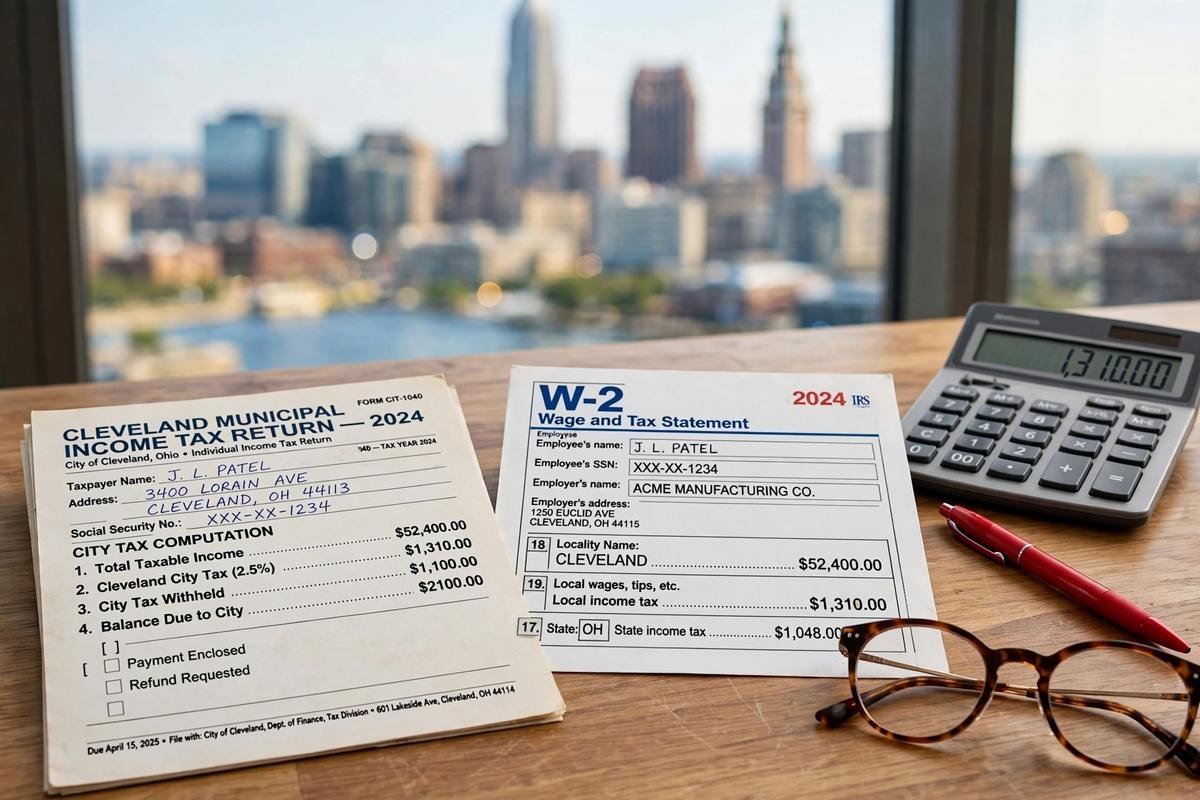
If your W-2 shows local tax withheld for an Ohio city you don’t live in — or two different Ohio cities — you’re not alone, and you’re not necessarily being double-taxed. Ohio is one of the only states where most workers owe income tax to their city as well as the state, and roughly 650 of Ohio’s municipalities levy their own income tax. This guide walks you, step by step, through figuring out which city (or cities) you owe, how the residence-city credit keeps you from paying twice, and exactly how to file with RITA and CCA.
New to the concept of city-level tax in Ohio? Start with our Ohio Municipal Income Tax Overview for the big picture before you file.
How Ohio City Tax Actually Works (The 60-Second Version)
Ohio’s municipal income tax runs on two simple rules:
- You file in the city where you live (your residence city). Normally you only file one return — in your city of residence. You do not file a return in the city where you work just because your employer withheld there, unless you actually owe that city something extra.
- Your residence city gives you credit for tax withheld for your work city. Most cities grant residents a credit (often up to the residence city’s own rate) for income tax paid to or withheld for another municipality. That credit is what prevents double taxation.
| Situation | What happens |
|---|---|
| Live and work in the same city | You pay that city’s tax on your wages. One return. Simple. |
| Live in City A, work in City B | Employer withholds for City B. You file in City A and claim credit for what was paid to City B. |
| Work in a city but live somewhere with no city tax (township, non-taxing village) | You may not owe anything beyond what was withheld for the work city — and your residence gives no credit because it levies no tax. |
| Retired, living only on pension/Social Security | Pensions, retirement benefits, and Social Security are exempt from Ohio municipal tax — but you may still need to file an exemption form the first year. |
Step 1: Find Out Which Agency Collects Your City’s Tax
Ohio cities either collect their own tax or use one of two collection agencies:
- RITA (Regional Income Tax Agency) — the larger of the two; it collects for hundreds of Ohio municipalities. File at ritaohio.com (Form 37 is the individual return).
- CCA (Central Collection Agency) — based in Cleveland; collects for Cleveland and member communities. File at ccatax.ci.cleveland.oh.us (eFile portal: efile.ccatax.ci.cleveland.oh.us).
- Self-collecting cities — Columbus, for example, collects its own tax and does not use RITA or CCA. Check the city’s own tax office site for its forms.
How to check: Look at your W-2. Box 18 lists the locality name(s) where tax was withheld and Box 19 shows the local tax amount. Then search the municipality list at ritaohio.com or ccatax.ci.cleveland.oh.us to confirm which agency handles your city. The Ohio Department of Taxation’s municipal income tax page also links to every taxing city’s site.
Step 2: Understand the Credit Math Before You File
This is the part that confuses everyone. Here’s the mechanism:
- Your residence city taxes all of your qualifying wages (wherever earned).
- Your employer withholds tax for the city where you physically work (your work city).
- When you file your residence-city return, you claim a credit for the tax paid to/withheld for the work city — capped at the residence city’s own tax rate. Credit percentages vary by municipality, so check your city’s official page or the RITA/CCA tax table for your exact credit limit.
That means:
- If the work city’s rate is lower than your residence city’s rate, you owe your residence city the difference.
- If the work city’s rate is equal or higher, you typically owe your residence city nothing (no extra payment, no refund of the difference either).
Step 3: Worked Examples (Illustrative Rates)
The rates below are illustrative examples to show the math — always look up your actual city’s rate and credit limit on that city’s official page or your agency’s tax table.
Example 1: Live in City A (2.5% illustrative), work in City B (2.0% illustrative)
Assumptions: You live in City A, which taxes residents at 2.5% and grants full credit for tax paid to other cities up to its own rate. You earn $60,000 in qualifying wages and your employer withholds 2.0% ($1,200) for work City B.
- City A tax on $60,000: $60,000 × 2.5% = $1,500
- Credit for tax paid to City B: $1,200 (up to the 2.5% cap)
- You file in City A only and pay: $1,500 − $1,200 = $300 with your return.
Example 2: Live in City C (1.0% illustrative), work in City D (2.5% illustrative)
Assumptions: You live in City C, which taxes residents at 1.0% and grants credit up to its own rate. You earn $50,000; your employer withholds 2.5% ($1,250) for work City D.
- City C tax on $50,000: $50,000 × 1.0% = $500
- Credit for tax paid to City D: capped at City C’s rate, so $500
- You file in City C and owe $0. (You do not get back the extra $750 withheld for City D — it belonged to City D.)
Example 3: Live in a township with no city tax, work in City E (2.0% illustrative)
Assumptions: Your township levies no income tax. You earn $45,000 and your employer withholds 2.0% ($900) for work City E.
- You owe no residence-city tax, and there is no return to file in your township.
- The $900 withheld for City E was properly withheld — City E taxed your work-site wages. No refund due.
- But: if any of that withholding covered days you did not actually work in City E (see the 20-day rule and remote-work FAQ below), you can file a nonresident return with City E’s agency to claim a refund.
Step 4: File Your RITA Return (Form 37)
If your residence city is a RITA member, your individual return is RITA Form 37 (Individual Municipal Income Tax Return). Residents age 18 and older must file an annual return even if no tax is due.
- Choose your filing method. E-file free at ritaohio.com using RITA’s online eFile system (MyAccount or FastFile). RITA will calculate your taxes in the eFile system. If you file electronically, no W-2 documentation is required at the time of filing, though RITA may request it afterward. Paper filers can download Form 37 and its instructions from the same site and mail the return.
- Enter your residence history. Form 37 requires the physical city/village/township of your residence for the whole year — this determines your taxing jurisdiction, and it can differ from your mailing address. If you moved during the year, list each address with its effective date.
- Report qualifying wages. In general, municipal taxable wages are the greater of your Medicare wages (W-2 Box 5) or local taxable wages (Box 18).
- Claim your credit for taxes paid to other cities. On Form 37, the credit for tax paid to/withheld for your work municipality is capped at your residence municipality’s credit limit — check the tax table in the Form 37 instructions for your city’s exact credit rate.
- Handle any over-withholding. Form 37 only calculates remaining tax due. If your employer over-withheld (more withheld than you owe), file RITA Form 10A (Application for Municipal Income Tax Refund) in addition to your return to get the refund.
A note for TurboTax users: TurboTax cannot e-file an Ohio city or RITA return — it must be printed and mailed. TurboTax also does not prepare the city return automatically; you have to start it yourself under the Ohio program’s “Ohio City taxes” section. Many filers find it easier to file directly at ritaohio.com.
Step 5: File Your CCA Return
If your city is a CCA member (including Cleveland), the Central Collection Agency administers it. CCA operates an eFile portal at efile.ccatax.ci.cleveland.oh.us for individual annual returns.
- On the CCA return, you list each city where you worked with its tax rate and taxable income (Section A), then report your residence tax and credits (Section B) — the same residence-city-credit mechanism described above.
- CCA states that individual taxpayers filing an annual return must submit a paper return (rather than eFile) if they have any of the following: business income on Schedules C or F, rental or K-1 activity on Schedule E, an overpayment (refund or credit due), or a W-2 from one employer listing multiple cities.
- Like TurboTax for RITA cities: TurboTax can prepare a CCA return but cannot e-file it.
Step 6: Deadlines, Extensions, and Estimated Payments
- Deadline: File your municipal return by April 15 (same as federal and Ohio state), or the next business day if April 15 falls on a weekend or holiday.
- Extensions: If you are on a federal extension, no separate municipal extension request is needed — just submit a copy of the federal extension with your extended municipal return (generally due October 15). Not on a federal extension? File RITA Form 32 (EST-EXT) by the return due date. Remember: an extension extends time to file, not time to pay — any tax you owe is still due April 15 to avoid penalties and interest.
- Estimated payments: If you expect to owe $200 or more in municipal tax beyond withholding, quarterly estimated payments are required. Estimated due dates follow the federal quarterly schedule.
- De minimis rule: Balances under $10.01 are neither collected nor refunded (this does not apply to employer withholding amounts).
- Penalties: RITA guidance notes a late-filing penalty of up to $25 per return — the city must abate it the first time you’re late, once the return is filed — and a 15% late-payment penalty on unpaid tax, plus interest at a rate set annually — so file even if you can’t pay in full.
Special Situations
Retirees
Pensions, retirement benefit payments, Social Security, disability benefits, and unemployment compensation are exempt from Ohio municipal income tax under state law. If you are retired with no taxable income (no W-2 wages or Schedule E income), RITA requires an Exemption form — but only for the first year this applies; you can file it electronically via MyAccount or FastFile. If you later earn taxable income again, resume filing Form 37.
The 20-day rule for traveling workers
Under Ohio’s “occasional entrant” rule (ORC 718.011), compensation earned by a nonresident in a municipality is exempt from that municipality’s tax if the employee worked there 20 or fewer days in the calendar year — and the employer is not required to withhold for those days. Once the employee crosses the threshold, the employer must withhold starting on day 21 (no retroactive withholding for days 1–20). Exceptions: the rule doesn’t apply if the city is your principal place of work, if a temporary work site is expected to last more than 20 days, or for professional athletes, entertainers, and public figures. And it never exempts you from your own residence city’s tax — you still owe that on all qualifying wages.
Working remotely from home
Post-pandemic, the normal rule is back: municipal tax follows where you physically work. If you are a fully remote employee working from your home in Ohio, your employer should withhold for your residence city. If your employer keeps withholding for the office city while you work 100% from home in a different city, that withholding is incorrect — you can file a return with the office city’s agency to claim a refund, and ask your employer to correct the withholding. (During 2020–2021 a temporary law deemed work-from-home days as office days; it expired December 31, 2021.)
You moved mid-year
You owe each residence city for the portion of the year you lived there, with credits for work-city withholding applying as usual. RITA Form 37 has a move-history section for listing each address with its effective date. If you moved into or out of Ohio, your state filing follows the separate Ohio resident/nonresident rules.
Under 18
Individuals under 18 are generally exempt from municipal income tax in RITA member municipalities (check your specific city’s notes on RITA’s municipality page, as minor exceptions exist).
Don’t confuse city tax with school district income tax
Ohio school district income tax (SDIT) is a completely separate tax with its own return — it is not covered by your RITA or CCA filing, and credit rules between city tax and SDIT do not apply. If your district levies one, see our school district income tax guide.
FAQ
1. Do I file in the city where I live or the city where I work?
You file in the city where you live. You normally do not file a return in the city where you work — your employer already sent that tax there through withholding, and your residence-city return claims credit for it. You’d only file in the work city if you have a refund claim (e.g., over-withholding or 20-day-rule days) or business income there.
2. Why does TurboTax prepare my RITA form but say I can’t e-file it?
TurboTax cannot e-file any Ohio municipal or RITA return — that’s a limitation on TurboTax’s side, not yours. Your options: print and mail the TurboTax-prepared return, or skip the TurboTax city section and file free directly at ritaohio.com (or the CCA eFile portal for CCA cities).
3. Am I being double-taxed? My W-2 shows city tax for two cities.
Almost certainly not double-taxed. Your employer is required to withhold for the city where you physically work. Your residence city then gives you credit for that withholding, so you only pay the difference if your residence city’s rate is higher. The credit appears on your residence-city return (Form 37 for RITA cities).
4. I worked only a few days in another city. Do I owe that city tax?
Under the 20-day rule, if you worked in a nonresident municipality for 20 or fewer days in the year, those wages are exempt from that municipality’s tax — unless that city is your principal place of work or an exception applies. Keep a day-by-day log; it matters.
5. I’m retired. Do I still have to file a city tax return?
Pensions, Social Security, and similar retirement income are exempt from Ohio municipal tax. If you have no taxable income at all, file an Exemption form with RITA for the first such year — then you’re done until your situation changes. If you pick up part-time W-2 work, you must file again.
6. I work from home but my employer withholds city tax for the office city. What now?
If you’re fully remote from an Ohio home, withholding should go to your residence city, not the office city. File a refund return with the office city’s agency for the incorrectly withheld tax, and ask your employer to fix the withholding going forward. The temporary pandemic rule that allowed office-city withholding expired December 31, 2021.
7. What if I can’t pay by April 15 — should I still file?
Yes. Late-filing penalties accrue separately from late-payment penalties (a flat late-filing penalty of up to $25 per return — first-time failures are abated once you file — while unpaid tax draws a 15% penalty plus interest). File on time and pay what you can; an extension gives you more time to file but never more time to pay.
8. Does my city return cover school district income tax too?
No. School district income tax is a separate system with its own filing requirement. Your RITA or CCA return does not satisfy it, and city tax credits don’t transfer to it. Check whether your district levies one and file accordingly.
Bottom line: find your agency (RITA or CCA), file in your residence city, claim credit for work-city withholding, and use the agency’s own free eFile portal instead of printing a TurboTax return. Do that, and the “two cities on my W-2” mystery disappears.