
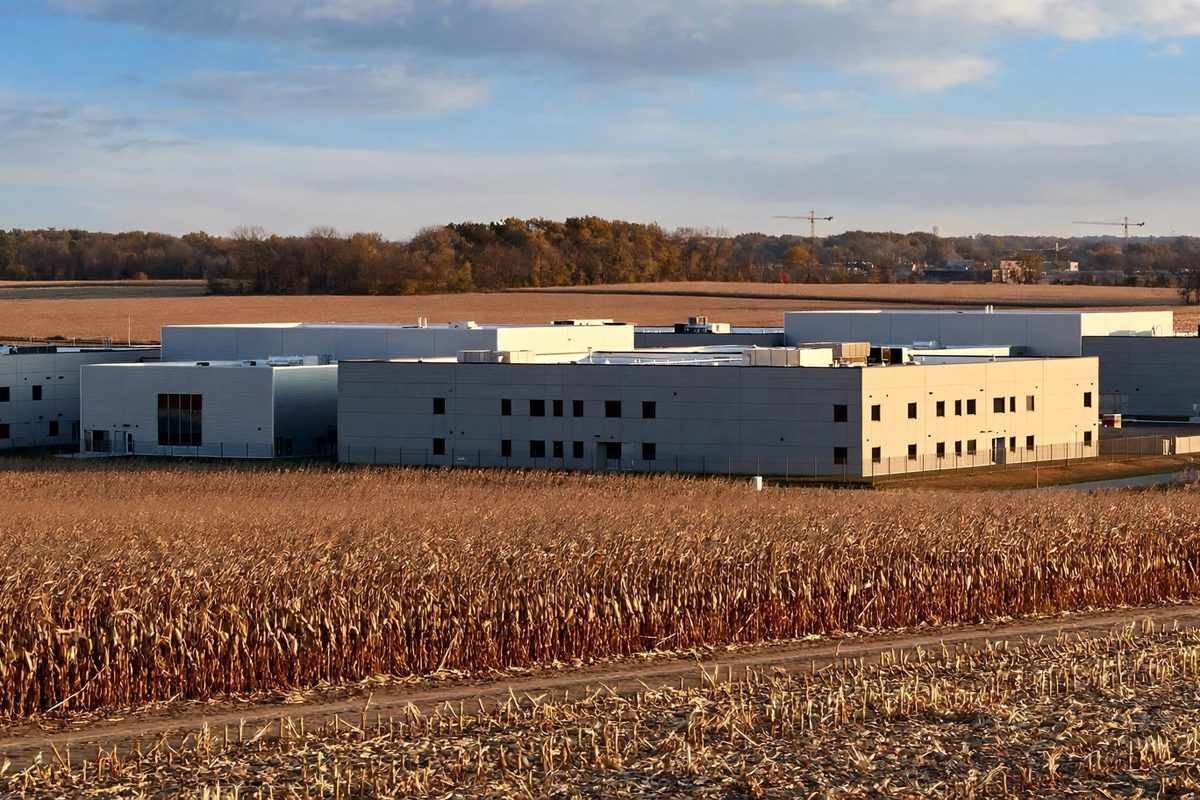
Meta’s Wood County data center gets a 75% property-tax exemption on each building for 15 years, while the land stays fully taxable. For the first two buildings, full taxes would be $3.42 million a year for tax year 2027, payable in 2028. Meta would pay about $2.10 million — 61% of the full bill — once its separate payments to the three school districts are counted.
The other local services would collect about $1.32 million a year less than full taxes, with no replacement payment.
This guide works through the deal in dollars. It uses Wood County’s own figures, as reported by the Lake Erie Inquiry on 15 November 2026. The headline correction is this: a 75% exemption is not a 75% saving. The $1.32 million is revenue that was never collected, not a cut from money those services already had.
The viral $600 million figure belongs to a different tax break entirely. It is the state equipment exemption, covered below — not the Wood County property-tax deal.
The short answer
Wood County’s first agreement gives Liames LLC — Meta’s land company — a 75% property-tax exemption on each building at the data center for 15 years. The land itself stays fully taxable. Three school districts — Eastwood, Otsego and Penta Career Center — have separate compensation agreements that replace much of what the exemption takes from them.
Every other local service that levies a property tax — the township, the county’s disability services and the Pemberville library — gets no replacement payment at all, and collects tax on only a quarter of the buildings’ value. The numbers below are the county’s estimate for the first two buildings on the Eastwood side, for tax year 2027, payable in 2028.
| Annual amount | |
|---|---|
| Full taxes on the two buildings | $3.42 million |
| What Meta pays (tax plus school payments) | about $2.10 million — 61% of full taxes |
| What non-school services do not receive | about $1.32 million a year |
That is the whole deal in one table. The rest of this guide explains where each number comes from, who is on each side of it, and what it does — and does not — mean for the people who live in Wood County.
How a property-tax abatement actually works
A property-tax abatement is an exemption a local government grants on new buildings. It usually runs through a community reinvestment area or an enterprise zone. Under Ohio law, these exemptions generally last up to 15 years.
The developer pays tax only on the value that is not exempted. A developer can also make separate payments to a school district or a township. In Wood County, the schools got those separate payments and the other services did not.
The exemption runs through a Community Reinvestment Area agreement under Ohio Revised Code § 3735.67.
What Meta actually pays — the 61% correction
Start with the misunderstanding, because it is the one that shapes every argument about the deal. A 75% property-tax exemption sounds as if Meta pays a quarter of the tax and keeps the other three quarters. It does not work like that, because the school payments sit on top of the reduced tax bill. Meta still pays property tax on 25% of each building’s value, like every other agency’s share.
Then it makes separate payments to the three school districts under their compensation agreements. Add the two together and the estimated bill for the first two buildings comes to about $2.10 million a year — 61% of the $3.42 million the buildings would owe with no exemption at all. The “saving”, if that is the word, is about 39%, not 75%.
The shortfall lands unevenly. The county workbook breaks out three agencies:
| Agency | Full annual tax | With the 75% exemption |
|---|---|---|
| Wood County Board of Developmental Disabilities (disability services) | $445,624 | $111,406 |
| Middleton Township, all levies (including the EMS levy) | $704,749 | $176,187 |
| Pemberville library | $54,323 | $13,581 |
Each of those is exactly a quarter of the full figure — the 25% of the tax base the exemption leaves behind. They are selected agencies, not a total: the $1.32 million shortfall covers every non-school levy on the two buildings, and the table shows only three of them. The school payments are the balancing item.
Meta’s ordinary tax bill on a quarter of the buildings’ value comes to roughly $855,000, so the school payments make up the rest of the $2.10 million — about $1.25 million a year. That matches a separate July 2026 estimate reported by The Columbus Dispatch, which put Meta’s annual payments to the affected school districts at a projected $1.2 million, according to Wade Gottschalk, Wood County’s economic development director.
Three cautions belong with these figures, and they matter. First, they are estimates from the county’s May 2026 workbook, calculated by the Lake Erie Inquiry and reviewed by Wood County Auditor Matthew Oestreich — not a tax bill. Oestreich cautioned that tax rates can change. Second, they cover only the first two buildings on the Eastwood side of the campus, for tax year 2027, payable in 2028.
They are not a bill for the whole campus, and they are not a forecast for the full life of the agreements. Third, the outlet that published them says plainly that its story was drafted by AI from public records and other named sources and then human-edited, and that “it will sometimes be wrong”. The figures are the county’s, reviewed by the auditor — but they are estimates, and they should be read as estimates.
Who gains and who loses
The schools come out of this deal protected. Eastwood Local Schools, Otsego Local Schools and Penta Career Center each negotiated a separate compensation agreement with the county, and the payments under those agreements replace much of what the 75% exemption takes off their share of the tax bill. The timing is staggered, and none of the money has arrived yet.
Eastwood told the Inquiry on Friday that it had received no payments and tentatively expected the first in the second half of fiscal 2028. Penta expects its first payments in calendar 2028. Otsego said in October that it expected its payments to begin around 2032. Construction progress and the valuation of the buildings decide when the money starts, so those dates can move.
Everyone else on the tax bill gets the raw end of the same arrangement. Middleton Township — including its EMS levy — the county’s disability services and the Pemberville library have no compensation agreement and no replacement payment. They collect tax on 25% of the buildings’ value and nothing on the other 75%.
That is the whole of the $1.32 million a year: money those agencies would have received if the buildings were taxed in full, and will not receive while the exemption runs.
It is worth saying plainly what that does and does not mean. The $1.32 million is revenue those agencies will not receive on new buildings. It is not a $1.32 million cut from money they already collect, and the records reviewed do not establish that the deal has caused service cuts. The distinction matters, because the deal is a choice about how to share the revenue from a new development — not a decision to take money out of an existing budget.
Our guide to Ohio school district tax explains how school funding works separately from these levies.
Why schools got a different deal
The split between schools and everyone else was not an accident, and the paper trail shows when it happened. In a letter dated 12 October 2023, the county told Penta Career Center that an earlier version of the later, second-stage agreement had included payments to the county’s non-school taxing agencies.
The change that followed lowered that phase’s exemption from 100% to 75% — leaving those agencies a quarter of the normal tax base instead of nothing — but the final version, in the Inquiry’s words, “lacks any payment scheme to the County’s non-school tax levying agencies”, while still providing for school protection.
The second phase follows the first 15-year exemption period and uses a different financing arrangement, which is why the one-year figures in this guide cannot simply be multiplied out to a 30-year total. Anyone who takes the $1.32 million a year and multiplies it by 30 is inventing a number the records do not support.
Why the non-school payments were dropped is, for now, unanswered. The Inquiry asked county administrator Carri Stanley and the county commissioners on Thursday 13 November why the payments had been removed and what the county had received in return — the same questions went to economic development director Wade Gottschalk — and no reply had been received by Sunday morning, when the story was published.
That is a “no reply by publication”, not a refusal, and if the county answers, the record should be updated. As of this guide’s publication on 17 November, no reply has been reported.
What Wood County gets in return
The county’s side of the bargain is the project itself. Meta announced the Bowling Green data center on 9 April 2025: a 715,000-square-foot campus on a 280-acre site in Middleton Township, an investment of more than $800 million, about 100 permanent jobs once complete — at an average salary of slightly more than $83,000, according to JobsOhio — and more than 1,000 construction workers on site at the peak of construction.
It is Meta’s 24th data center in the United States and its 28th in the world. It is Meta’s second data center in Ohio, after New Albany. JobsOhio points to the knock-on business for construction, maintenance and other local service providers.
Projections are not results, and three gaps in the record are worth naming. The announcements do not show how many of the 100 permanent jobs have been filled, how much of the construction and maintenance spending stays in Wood County, or whether Meta would have built here without the incentives. None of those questions has a public answer yet.
In a statement on Friday, a Meta spokesperson said the company had invested more than $2.3 billion in its Ohio data centers since 2018, created thousands of jobs and paid more than $40 million in state property taxes and fees. Those are cumulative figures for all of Meta’s Ohio operations — not the annual return from the Wood County project — and they should not be read as if they were.
The other tax break — the state equipment sales-tax exemption
The property-tax deal is not the only tax break on this project, and confusing the two is the easiest way to get the numbers wrong. Ohio also exempts data-center equipment — servers, cooling systems and related purchases — from state sales tax. That exemption is a state programme, negotiated with the Ohio Tax Credit Authority, and it is far larger than the Wood County deal.
In fiscal year 2025 the equipment exemption cost the state $1.568 billion in forgone revenue, on the Ohio Department of Taxation’s own May 2026 calculation as reported by Signal Ohio — up from $554.9 million in 2024, and roughly twelve times the $133 million a year the state had estimated.
A new October 2026 study by Good Jobs First and Policy Matters Ohio puts the same 2025 cost at almost $1.6 billion in forgone revenue. That is the same Ohio Department of Taxation figure — $1.568 billion — rounded, not a second cost. The study adds that about $374 million of it could have supported traditional public schools, or about $262 per student.
The study says that amount would have been enough to close the funding gap in the Fair School Funding Plan. That is the study’s estimate of what the money could have funded, not money taken from school budgets. As of June 2026, the state had 21 data-centre agreements in place.
A second bill would go further than H.B. 646. Senate Bill 374, sponsored by Senators Louis Blessing and Kent Smith, would prohibit the state from granting new data-centre sales-tax exemptions beginning in October 2027. It received its first hearing in the Senate Finance Committee on 17 November 2026, with Senators Blessing and Smith giving sponsor testimony. Four other Democrats have also signed on as co-sponsors.
The bill would not touch existing deals. The Wood County agreement and the Kasich-era statewide agreements would continue as they are. Only new exemptions after October 2027 would stop.
The cost figure behind the bill is the same one in the study above. The Ohio Department of Taxation put the exemption’s 2025 cost at almost $1.57 billion, against an original estimate of about $130 million a year. That is why the bill’s supporters say the exemption has grown far beyond what lawmakers expected.
Governor DeWine directed the Tax Credit Authority to stop taking new exemption requests on 27 May 2026, and said in August that the freeze would last through the end of his term. Existing agreements are untouched by the freeze.
This is where the viral $600 million figure comes from. Between 2014 and 2018, under Governor John Kasich, Amazon, Meta and Google each signed statewide agreements granting a 100% sales-tax exemption on data-center equipment anywhere in Ohio, for as long as 40 years if the companies hit their investment targets — worth about $600 million each, running as late as 2058. Those agreements remain in force.
So when a post says Ohio politicians “secretly awarded” the three companies $600 million in tax breaks, it is describing the Kasich-era state equipment exemption — not the Wood County property-tax deal, and not a secret: the agreements are public record.
The state break is also the one with the lowest bar. Under Ohio Revised Code 122.175, a qualifying facility needs at least $100 million of investment over three years and $1.5 million of annual payroll at the site. All told, the state has now committed more than $2.1 billion in data-center sales-tax exemptions.
Companies holding the exemption reported $27.2 billion of capital investment in Ohio in 2025, the governor’s office noted when the freeze was announced.
One more Ohio tax applies to the project that this guide does not price: the state’s Commercial Activity Tax on business gross receipts. Our Ohio CAT guide explains how that tax works.
How Wood County’s deal compares with other Ohio deals
Property-tax abatements are negotiated town by town. Wood County’s deal sits inside a familiar pattern across Ohio.
In New Albany, Microsoft and Meta received 15-year local property-tax exemptions. Amazon Web Services received a 30-year abatement — nothing for the first 15 years, then 75% relief for the next 15.
The 75% figure in Wood County is not unusual. What is unusual is that the schools were protected and the other local services were not.
What H.B. 646 would change for the next deal
If the Wood County deal looks generous, the legislature has spent 2026 arguing about whether the next one should be. House Bill 646, the data-center bill of the 136th General Assembly, passed the House 97–0 on 18 March 2026 and was reported by the Senate Energy Committee on 10 June. The Senate then informally passed it and recommitted it to the same committee on the same day — and it has not moved since.
Full sessions resume on Wednesday 18 November, and whether the bill moves in the lame-duck session is an open question.
As reported, the bill would cap future data-center property-tax exemptions — through community reinvestment areas, tax increment financing and enterprise zones — at 50% of the improved value, cap the data-center equipment sales-tax exemption at 50%, and require security for a developer’s obligations. It would apply prospectively: agreements already made, including Wood County’s, would continue under the law that existed when they were made.
A 50% cap on the next deal would still leave a large exemption — but the township, the library and disability services would collect on half the buildings’ value instead of a quarter.
The politics around the bill shifted on 3 November, when voters in 18 Ohio communities decided 21 ballot measures on data-center development — most of them restrictions. In Wilmington, voters rejected all four referendums that would have rezoned land for data centers, defeating each by about 80% of the vote.
The legislature’s answer, if it gives one, comes in the lame-duck session that runs to the end of the year; if the 136th General Assembly does not act, the 137th starts from scratch in January.
What this means for a Wood County homeowner
The honest short version: nobody is sending you a bill for the $1.32 million. It is tax revenue the township, disability services and the library will not collect on new buildings — measured against what full taxation would produce, not against the money they collect today.
No service cuts caused by the deal have been established, and your school district’s funding is unaffected by this agreement: the schools negotiated their own payments, and school levies are voted on separately. Our November 2026 levies guide explains how those levies work.
The agencies still collect something they did not have before — tax on a quarter of the value of buildings that did not exist until this project. The question the deal really raises is about the next negotiation, not your next tax bill: if those agencies need more money in future, they will have to ask voters for it through a levy, and the voters who decide will be the same people who watched this deal get made.
For the wider picture of how Ohio property tax is worked out, see our Ohio property tax guide and the Ohio tax rates hub.
Frequently asked questions
What tax break did Meta get in Wood County?
A 75% property-tax exemption on each building at its data center north of Bowling Green, for 15 years, granted to Liames LLC, Meta’s land company. The land itself remains fully taxable. Eastwood, Otsego and Penta Career Center have separate compensation agreements; the township, the county’s disability services and the Pemberville library get no replacement payment and collect tax on only 25% of the buildings’ value.
How much tax does Meta actually pay on the data center?
On the first two buildings, for tax year 2027 (payable in 2028), the county estimates full taxes of $3.42 million a year. Meta would pay about $2.10 million — its reduced tax bill plus the school payments — which is about 61% of the full amount. The remaining shortfall, about $1.32 million a year, falls on the non-school services. These are county workbook estimates reviewed by the county auditor, not a tax bill for the whole campus.
Why do the schools get paid but not the township or the library?
The three school districts each negotiated a separate compensation agreement with the county. An earlier version of the later, second-stage agreement had included payments to the non-school agencies, but the final version dropped them while keeping the school protection, according to a county letter of 12 October 2023. The county has not explained why: asked on 13 November, it had given no reply by the time the story was published on 15 November.
Does the deal cut existing services?
No cut has been established. The $1.32 million a year is revenue the township, disability services and library will not receive on new buildings — it is not money taken out of their existing budgets, and the records reviewed do not establish that the deal has caused service cuts. The agencies still collect tax on a quarter of the buildings’ value, on buildings that did not exist before the project.
How long does the exemption last?
Fifteen years for each building under the county’s first agreement. A second phase follows the first 15-year period under a different financing arrangement, so the one-year figures in this guide cannot be multiplied out to a 30-year total.
What happens after the 15 years?
Under the first agreement the buildings return to full taxation when the exemption period ends. What exactly follows is set out in the second-phase agreement, which uses a different financing arrangement — the public record reviewed for this guide does not price that phase building by building, which is why no multi-decade total is given here.
What is Liames LLC?
Liames LLC is Meta’s land company — the entity named in Wood County’s first agreement as the recipient of the 75% exemption on each building. The land itself stays taxable; only the buildings are exempted.
Does Ohio give data centers a sales-tax break too?
Yes, and it is a separate, much larger break. Ohio exempts data-center equipment from state sales tax under Ohio Revised Code 122.175. The exemption cost the state $1.568 billion in forgone revenue in fiscal year 2025, up from $554.9 million in 2024. Governor DeWine froze new awards on 27 May 2026, but the Kasich-era agreements — 100% exemptions for up to 40 years, worth about $600 million each — remain in force.
What would H.B. 646 change?
As reported, House Bill 646 would cap future data-center property-tax exemptions at 50% of the improved value and the equipment sales-tax exemption at 50%, and require security for a developer’s obligations. It would apply only to future deals — Wood County’s agreement would continue as it stands.
The bill passed the House 97–0 in March 2026 but has sat in the Senate Energy Committee since it was recommitted on 10 June; full sessions resume on 18 November 2026.
Where do the numbers in this guide come from?
From Wood County’s May 2026 tax workbook, as reported by the Lake Erie Inquiry on 15 November 2026, with the calculations reviewed by Wood County Auditor Matthew Oestreich. The figures cover the first two buildings on the Eastwood side of the campus for tax year 2027, payable in 2028.
The Inquiry notes its story was drafted by AI from public records and other named sources and human-edited, and that it “will sometimes be wrong” — so the figures here are presented as county estimates, not settled bills.
Sources
- Lake Erie Inquiry — “Meta’s tax deal protects schools more than other local services”, 15 Nov 2026, updated 2:05 p.m. (story code LEINQ-261115, edited by Zach Brooke) — primary source for the Wood County figures; the outlet notes the story was drafted by AI from public records and other named sources, human-edited, and “will sometimes be wrong”. Figures come from Wood County’s May 2026 workbook; calculations reviewed by Wood County Auditor Matthew Oestreich: https://lakeerieinquiry.org/stories/2026-11-15
- Wood County May 2026 tax workbook (via the Lake Erie Inquiry).
- Wood County community reinvestment area / tax increment financing agreements and the county’s 12 October 2023 letter to Penta Career Center (via the Lake Erie Inquiry).
- Meta — “Hello, Bowling Green!”, 9 Apr 2025 (715,000 sq ft campus, 280 acres in Middleton Township, more than $800 million investment, about 100 jobs, more than 1,000 construction workers at peak): https://datacenters.atmeta.com/2025/04/hello-bowling-green/
- JobsOhio / Regional Growth Partnership — “Regional Growth Partnership and JobsOhio Welcome Meta to Northwest Ohio with New $800 Million Data Center Announcement”, 9 Apr 2025 (average salary of slightly more than $83,000, per JobsOhio, as reported at the announcement): https://www.jobsohio.com/newsroom/news-press/regional-growth-partnership-and-jobsohio-welcome-meta-to-northwest-ohio-with-new-800-million-data-center-announcement
- The Columbus Dispatch — “Amazon, Meta avoid millions in property taxes for Ohio data centers”, 16 Jul 2026 (projected $1.2 million a year in school payments, per Wood County economic development director Wade Gottschalk): https://www.dispatch.com/story/news/politics/state/2026/07/16/ohio-data-centers-benefit-from-millions-in-property-tax-breaks/90607945007/
- Signal Ohio — reporting on the Ohio Department of Taxation’s May 2026 calculation that the data-center equipment sales-tax exemption cost $1.568 billion in 2025 ($554.9 million in 2024), and that the state has committed more than $2.1 billion in total: https://signalohio.org/ohio-approves-last-data-center-exemption-before-moratorium/
- Policy Matters Ohio — “Why are Ohio kids paying for data centers?”, Nov 2026 (corroborates the $1,568,700,000 figure for 2025, from Ohio Department of Taxation figures as reported by Signal Ohio): https://policymattersohio.org/research/why-are-kids-paying-for-data-centers-in-ohio/
- Ohio Legislature — H.B. 646 bill analysis, as reported by Senate Energy, 10 Jun 2026: https://www.legislature.ohio.gov/download?key=28589 ; bill status page: https://ohiohouse.gov/legislation/136/hb646
- Ohio Revised Code 122.175 — data-center sales and use tax exemption ($100 million investment over three years; $1.5 million annual payroll): https://codes.ohio.gov/ohio-revised-code/section-122.175
- Morning Ag Clips — “Data Centers Lose Big on Ohio Ballots”, 8 Nov 2026 (21 ballot measures in 18 Ohio communities on 3 Nov 2026; Wilmington rejected all four rezoning referendums by about 80%): https://www.morningagclips.com/data-centers-lose-big-on-ohio-ballots/
- Social listening (reader language, not facts): Wood County Republicans “Data Center Playbook” graphic, Instagram, 22 Sep 2026; FactPost (@factpostnews) post on the $600 million figure; Bowling Green finances post, Nov 2026. Claims in these posts about NDAs, official conduct and public participation are the posters’ characterisations and are not repeated here as fact.
- Good Jobs First, 5 November 2026 — ‘Why are Kids Paying for Data Centers in Ohio?’: https://goodjobsfirst.org/why-are-kids-paying-for-data-centers-in-ohio/
- Policy Matters Ohio / Good Jobs First, October 2026 — ‘Why are Kids Paying for Data Centers in Ohio?’ (PDF): https://policymattersohio.org/wp-content/uploads/2026/11/Kids-Pay-for-Data-Centers.pdf
- Fostoria Free Press, 20 November 2026 — ‘Data Center Tax Breaks Under Threat at the Statehouse’: https://thefostoriafreepress.com/ohio-data-center-tax-breaks-under-threat-statehouse/ ; Ohio Legislature S.B. 374 status page: https://www.legislature.ohio.gov/legislation/136/sb374
Tax disclaimer: This guide is general information about Ohio property tax and data-center tax incentives as they stand in November 2026. It is not tax advice. The Wood County figures are county estimates for two buildings for tax year 2027, reviewed by the county auditor — not a tax bill — and H.B. 646 may change the rules for future deals. Check with the Wood County Auditor’s office or a tax professional before acting on anything here.