
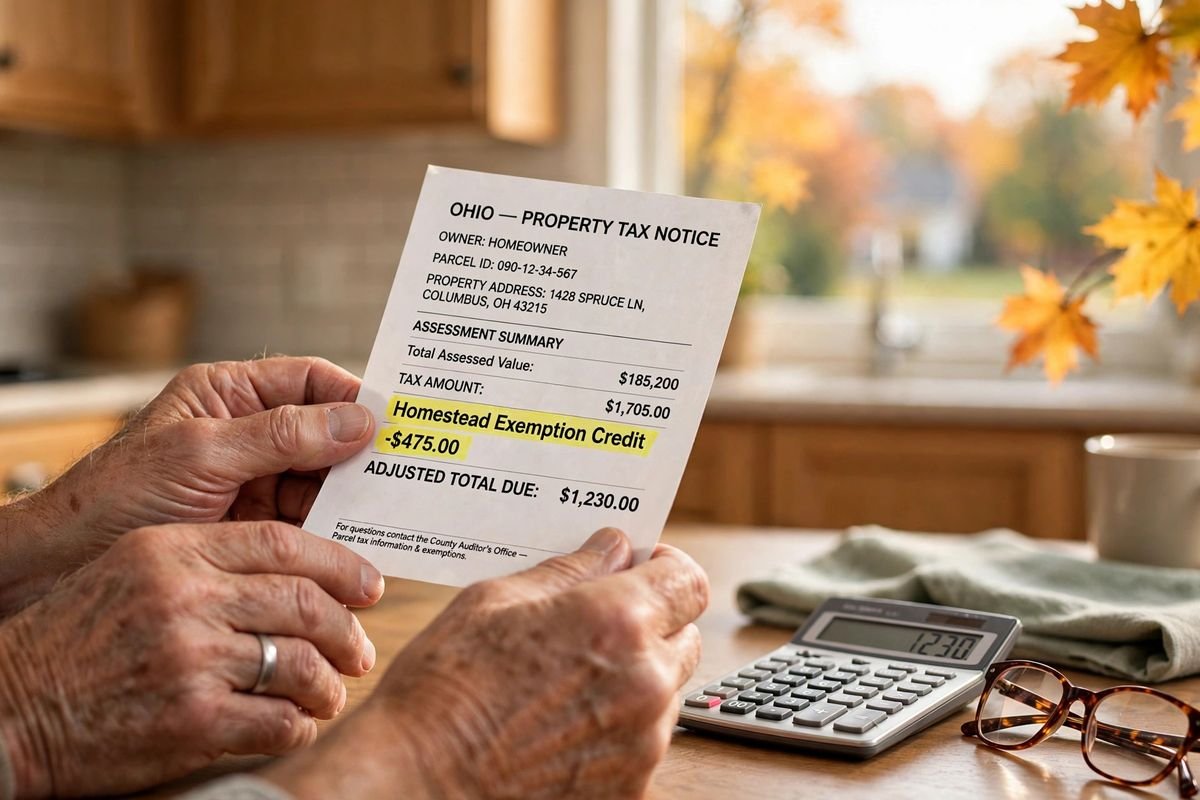
If you already get Ohio’s homestead exemption, roughly $450 to $500 is about to come off your property tax bill — automatically. You don’t need to apply for it, you don’t need to claim it anywhere, and it isn’t a scam. It is a one-time property tax credit created by House Bill 479, signed into law in June 2026 and funded from Ohio’s budget surplus, and it will show up on the property tax bills mailed out in early 2027.
On October 21, 2026, the Richland County Auditor’s office put out the clearest explanation yet: the roughly 710,000 Ohioans who receive the homestead exemption will see the money as a second Homestead Exemption credit line on their tax year 2026 bills, which are mailed in February 2027. No new application is required.
That’s the good news. The catch — and the reason this guide exists — is that the amount is not a guaranteed $500, the deadlines flying around on social media are county processing cutoffs rather than state law, and this credit is being confused with at least four other programs and proposals that are not the same thing. This guide separates them all, answers the exact questions Ohioans are actually asking, and flags the scams that are already circling.
The One-Time Credit at a Glance
| Detail | What it is |
|---|---|
| What | One-time property tax credit of roughly $450–$500 per eligible home |
| Created by | House Bill 479 (136th General Assembly), signed by Gov. Mike DeWine in June 2026 |
| Funding | $350 million from the FY 2026 state budget surplus (Property Tax Relief Fund) |
| Who gets it | ~710,000 Ohio homeowners receiving the homestead exemption for tax year 2026 (tax year 2027 for manufactured/mobile homes) |
| How it arrives | As a second Homestead Exemption credit line on your property tax bill — not a cheque, not a rebate |
| When | On bills mailed in early 2027 (January–February for most homeowners, depending on the county) |
| Do you need to apply? | No — if you already receive the homestead exemption. Newcomers must apply for the underlying exemption by December 31, 2026 |
| Is it permanent? | No. One year only — with one permanent bonus hidden in the same bill (see below) |
What This Credit Actually Is
House Bill 479 started life as a radiology bill and was transformed in the Senate Finance Committee into a “budget cleanup” bill carrying amendments that redirected part of the state’s FY 2026 budget surplus — revenues came in more than $1.3 billion above estimates — toward tax relief. The House agreed to the amendments 89-5.
The headline provision: a $350 million Property Tax Relief Fund used to reimburse counties, cities, townships, and school districts for a one-year property tax reduction given to every homeowner who receives the homestead exemption. Because the state reimburses the local governments, your schools and local services don’t lose the money — the state pays the difference.
How the money gets divided: county auditors certify how many homestead exemption properties are in their county, county treasurers certify the reductions applied to first-half and second-half tax bills payable during 2027, and the Ohio Tax Commissioner calculates the per-home reduction. State Rep. Daniel Troy, a co-sponsor, put it plainly: the reserved funds are divided equally among eligible homeowners — which is why officials quote a range rather than a fixed figure. $350 million divided by roughly 710,000 recipients works out to about $493 per home, and legislators have consistently estimated $450 to $500. Rep. David Thomas called it an average of $475.
Who Gets the Money
The rule is simple: if you receive the homestead exemption for tax year 2026, you get the credit — standard or enhanced exemption, both count. The underlying exemption goes to homeowners whose primary residence qualifies under one of these categories:
- Seniors age 65 or older — must be 65 by December 31 of the application year, with household income of $41,000 or less (based on prior-year Ohio adjusted gross income).
- Permanently and totally disabled homeowners — same $41,000 income limit, with a disability certification attached to the application.
- Surviving spouses — same income limit and standard exemption rules continue.
- Disabled veterans and surviving spouses of first responders — qualify for the enhanced $58,000 exemption with no income limit at all.
Two details from the income test matter enormously:
- Social Security income does not count. The $41,000 ceiling excludes Social Security entirely. If you assumed your benefits push you over the limit, you may be wrong — check the countable figure before ruling yourself out. (Ohio also doesn’t tax Social Security benefits as income at all — see how Ohio treats Social Security.)
- A spouse’s taxable income does count. It is household income that is tested, not just the applicant’s.
One more exception: if you received the homestead exemption in 2013 or earlier, you are grandfathered — the income limit does not apply to you at all, even if you moved to a different home.
This is where a real misconception needs clearing up. In comment threads about the credit, veterans have written things like “not a single P&T veteran qualifies. They receive 47,970.96 annually” — reasoning that VA disability pay puts them over the $41,000 income test. But 100%-disabled veterans fall under the enhanced exemption, which has no income limit, and enhanced recipients get the one-time credit just like everyone else. If a veteran told you they “never qualify,” get a second opinion from your county auditor before giving up.
For the full picture of the underlying program — worked examples of what the exemption itself saves, the disability forms, the grandfathering rule — see our complete Ohio homestead exemption guide.
How Much You’ll Actually Get — and the “$500” Confusion
Here is the thing Facebook threads keep getting wrong: nobody has promised every homeowner exactly $500. The law sets aside $350 million and divides it among the homes counties certify. The final per-home figure depends on the certified count, and it is the Tax Commissioner’s job to calculate it. Officials’ estimates range from $450 to $500; the arithmetic on today’s numbers lands near $493.
Expect a figure somewhere in that band, not a round number, and do not plan around $500 exactly. Also remember what the LBO fiscal note says: the reduction is applied across first-half and second-half bills payable during 2027, so depending on how your county structures it, you may see part of the credit on your first-half bill and the remainder on the second-half bill rather than one lump sum.
For perspective: one commenter mocked “$475 is a joke. They’ll give you $500 and raise them more than double that!” while another answered “Can’t Thank You Enough Kyle!!! For some of us, that is a HUGE relief!” Both reactions are honest. Against a multi-thousand-dollar bill in a high-tax district, $475 is a token. For a fixed-income senior whose tax bill is only a few hundred dollars, it can erase most of a year’s bill. State Rep. Bride Rose Sweeney made the same point from the other side: “For those people who will receive it, this is going to be incredibly helpful. But next year, because this money is one time, they will still be in the same position.”
When and How It Appears on Your Bill
Look for a second “Homestead Exemption” credit line on your property tax bill. That’s the official description from the Richland County Auditor’s October 21, 2026 announcement: the credit appears as an additional Homestead Exemption credit on tax year 2026 bills mailed in February 2027.
State officials have described the timing slightly differently — Sen. Nathan Manning’s office said the credit would be applied on the January 2027 statement, while the legislative budget office says treasurers will certify reductions on first-half and second-half bills payable during calendar 2027. These aren’t contradictions; counties mail on different schedules. Your bill’s exact arrival month depends on your county. The credit is tied to tax year 2026, payable in 2027 — so it is the bill you receive in the first weeks of 2027.
If you live in a manufactured or mobile home, the mechanics differ: the LBO fiscal note says the credit covers owners of manufactured or mobile homes for tax year 2027 (reflecting their different assessment cycle). Check with your county auditor for exactly which bill shows it.
Do You Need to Apply? Untangling the Deadline Mess
The single most-asked question, word for word: “Do we need to apply if we’re already on this homestead exemption?”
If you already receive the homestead exemption: no. The credit is automatic. You do not file anything, call anyone, or claim anything anywhere. The county applies it to your bill.
If you don’t receive the exemption yet but might qualify: you need to apply for the underlying homestead exemption — not for the credit separately. The application is Form DTE 105A (seniors, disabled homeowners, surviving spouses) or DTE 105I (disabled veterans), filed with your county auditor, and the legal deadline for real property is December 31, 2026 for tax year 2026. (Manufactured and mobile homes: the first Monday in June.) Miss the underlying exemption and you miss the credit too.
Now the deadline confusion. Viral county flyers have carried wildly different cutoffs: Butler County said October 2, 2026; a Montgomery County reel said October 23; Lucas and Sandusky counties said October 30. Meanwhile the law says counties certify their homestead counts by November 1, and the statute says the homestead application deadline is December 31. So which is real?
All of them are “real” for different purposes. The October dates are county-set processing cutoffs — auditors want new applications in hand in time to review them and include the homes in the November 1 certification. The November 1 certification is the state’s count used to divide up the $350 million. December 31 is the legal deadline for the exemption itself. The practical advice: if you are applying for the first time, file now — don’t gamble on a late-December application still making the cut. County auditors have run in-person application clinics this autumn precisely because the process intimidates people; Franklin County’s auditor held clinics on October 21, November 12, and December 2.
And since TurboTax Community threads prove people ask: the homestead exemption does not go on your income tax return. You never enter it on a 1040 or an Ohio IT 1040. It is a credit your county applies to your property tax bill. If you were looking for a line on your tax return, that’s why you can’t find one.
Two Worked Examples
Example 1: senior homeowner, currently enrolled. Margaret is 74, owns her home in Lucas County, and has received the homestead exemption for years. She does nothing. On her first 2027 bill she sees the usual Homestead Exemption credit line — plus a second one worth roughly $475. Combined with her standing exemption savings of a few hundred dollars, her 2027 bill drops meaningfully — and she can pair it with the Ohio retirement income credit for seniors on the income-tax side.
Example 2: newly eligible senior, applying now. Robert is 66, retired, with $28,000 in pension income and Social Security on top (Social Security doesn’t count). He downloads DTE 105A from his county auditor’s website, files it before his county’s processing cutoff, and is approved for tax year 2026. He gets both the standing $29,000-value exemption and the one-time ~$475 credit on his 2027 bills.
The Permanent Bonus Hidden in the Same Bill
Almost all coverage focuses on the one-time credit, but H.B. 479 did something else that lasts: it fixed the homestead exemption’s own math.
A 2025 law (H.B. 186) created an inflation cap on the 20-mill floor — the mechanism that stops school-district tax increases from automatically rising with property values. The problem: the way it was drafted, the cap credit was subtracted before the homestead exemption was calculated, unintentionally shrinking the exemption. H.B. 479 specifies that the homestead exemption amount is computed before the H.B. 186 inflation-cap credit. The Ohio Legislative Service Commission estimates this fix increases exemption savings by about $44 million per year, beginning with tax year 2026 — and the state reimburses local governments for it, so schools and services don’t lose out.
In plain English: on top of the one-time credit, the standing homestead exemption itself got slightly more generous starting this tax year — permanently.
What Happens in 2028
The one-time credit is exactly that: one time. It does not permanently change the homestead exemption program and does not create a new annual reduction. In 2028 your bill returns to the standing exemption only (plus the permanent calculation fix above).
This is the core of the criticism from county auditors and some legislators. Hamilton County Auditor Jessica Miranda praised the funding but called for “more long-term relief,” noting that thousands of older Ohioans are locked out by the income ceiling enacted after 2013. Others have pushed further — the “Ax the Tax” campaign is gathering signatures for a property-tax abolition effort, and HJR 7 (a constitutional amendment to exempt owner-occupied homes from property tax entirely) exists but sits in a House committee, far from the ballot. Meanwhile, proposed alternatives like H.B. 365 (a refundable income-tax credit for homeowners and renters whose property taxes exceed 5% of income) remain pending in a House committee — not law — and H.B. 156 (a senior property-tax freeze) is still just a proposal.
Knowing these names matters because they keep getting mixed up with H.B. 479 in comment threads. Only H.B. 479’s credit is law and paying out. Everything else is a proposal, a campaign promise, or a petition — and the tax questions actually on this November’s ballot are local school and municipal levies, not a statewide property-tax amendment.
Don’t Get Scammed
Real money attracts fake programs, and seniors are the target. In August 2026 the Fairfield County Auditor warned about viral videos falsely claiming a federal property-tax relief program for older homeowners — telling seniors to submit a “Senior Homeowner Tax Review Request.” The auditor’s response: “There is no such thing as a Federal Senior Homeowner Tax Review Request form.” There is also no federal senior property-tax freeze and no federal program that “legally exempts” seniors from property tax, despite what some engagement-bait reels claim.
How to tell the real credit from a scam:
- The real credit comes as a line on your tax bill. Nobody mails you a cheque for it, nobody calls you about it, and there is no website to “claim” it.
- You never apply for the credit itself. Anyone asking you to submit personal information to “register” for the H.B. 479 credit is not from the government.
- Ohio has no senior property-tax freeze. Reaching 80 does not exempt you from property tax. Bills proposing a freeze (like H.B. 156) have not passed.
- When in doubt, call your county auditor directly — the number on their official website, not one from a video or text message.
What This Is NOT: The Confusion Checklist
Ohio property-tax news has been a blur of bill numbers. Keep this list:
- Not H.B. 365’s property tax refund. That proposal (refundable credit when property taxes exceed 5% of income, renters included) is pending in the House Ways & Means Committee — not law.
- Not HJR 7’s abolition amendment. The constitutional amendment to exempt owner-occupied homes from property tax is still only “offered” in a House committee — not adopted, not on any ballot.
- Not a senior tax freeze. H.B. 156’s proposed freeze is a proposal, not law. No Ohio homeowner is “legally exempt” from property tax by age alone.
- Not the gas-tax holiday. H.B. 519’s motor-fuel tax holiday (October 4, 2026 – January 2, 2027) is a separate program.
- Not a campaign rebate. Proposals like a $1,000 rebate for homeowners whose bills jump more than 4% are campaign promises, not law.
- Not H.B. 274’s 20-year homeowner exemption. That proposed third enhanced exemption passed only one chamber — not law.
FAQs
Do I need to apply for the one-time credit if I already get the homestead exemption?
No. This is the most-asked question and the answer is simple: if you already receive the homestead exemption, the credit is automatic. It appears on your 2027 bills without any action from you.
Is the credit really $500?
Not exactly. The law set aside $350 million, divided among the homestead homes counties certify — the Ohio Tax Commissioner calculates the final per-home figure. Officials estimate $450 to $500; the arithmetic lands near $493. Expect a figure in that range, applied across your first-half and second-half 2027 bills, not necessarily a single lump sum.
I saw an October deadline on a county flyer. Is December 31 too late?
The October dates are county processing cutoffs — auditors want applications in time for the November 1 state certification. December 31 is the legal homestead application deadline. Practically, file now: an application processed after your county’s certification may still qualify you for the exemption but could miss the one-time credit. Call your auditor if you filed late.
My income is just over $41,000. Am I out?
Maybe not. Social Security is excluded from the $41,000 test entirely, so your countable income may be lower than you think. If you were grandfathered by receiving the exemption in 2013 or earlier, the income limit doesn’t apply to you at all. And if you’re a 100%-disabled veteran, the enhanced exemption has no income limit.
I’m a disabled veteran on VA disability. Do I qualify?
Likely yes. The enhanced $58,000 homestead exemption for honorably discharged veterans with a 100% service-connected disability rating (or IU compensation at the 100% rate) has no income limit — VA disability pay doesn’t disqualify you. Enhanced recipients get the one-time credit too.
Can the credit make my property tax bill zero or negative?
Property tax credits reduce what you owe; they don’t pay you. If your bill after all credits is very small, the one-time credit covers what remains — you simply owe less, not a refund beyond zero.
I pay my property taxes through mortgage escrow. Do I still get it?
Yes. The credit reduces your tax bill, and your mortgage servicer pays the lower amount from escrow. Escrow analyses typically run once a year, so the lower bill usually shows up as a smaller monthly escrow payment or an escrow surplus refund at the next analysis — ask your servicer if you want to know exactly when.
Does the credit affect my federal or Ohio income taxes?
A property tax credit isn’t income — it’s a reduction of a bill you owe. It doesn’t appear on your 1040 or your Ohio IT 1040. One indirect effect: if you itemize deductions and deduct property taxes, you deduct only the net amount you actually paid, so the credit slightly reduces that deduction.
Is this the same as the senior property-tax freeze I’ve been hearing about?
No. The freeze (H.B. 156) is a proposal that has not become law. H.B. 479’s one-time credit is law and will appear on 2027 bills. They’re completely different ideas — one is a temporary automatic credit, the other is a proposed permanent freeze.
What happens to my taxes in 2028?
The one-time credit disappears — your bill returns to the standing homestead exemption only. The one lasting piece of H.B. 479 is the permanent fix to the exemption’s calculation (worth about $44 million a year statewide starting with tax year 2026), which slightly increases the standing exemption for everyone on it.
Sources
- Ohio Legislative Service Commission, Fiscal Note & Local Impact Statement for H.B. 479 (As Passed by the Senate, June 10, 2026) — fund mechanics, per-home calculation, manufactured-home timing, $44M/yr permanent exemption fix — legislature.ohio.gov
- Mansfield News Journal (Oct 21, 2026), “Some Ohio home owners will get extra property tax relief” — Richland County Auditor Pat Dropsey announcement: $450–$475, second Homestead Exemption credit line, February 2027 mailing, no new application — mansfieldnewsjournal.com
- State Rep. Daniel Troy press release (ohiohouse.gov) — $450–$500 range, standard/enhanced recipients, funds divided equally, 89-5 House vote — ohiohouse.gov
- State Sen. Nathan Manning press release (ohiosenate.gov, June 15, 2026) — $350M fund, ~710,000 recipients, January 2027 statement, $41,000 income ceiling — ohiosenate.gov
- State Rep. David Thomas press release (ohiohouse.gov) — “average of $475,” $320M sales-tax-holiday fund — ohiohouse.gov
- Hamilton County Auditor Jessica E. Miranda press release (July 1, 2026) — income ceiling detail, how to check status/apply — hamiltoncountyauditor.org
- Ohio Education Policy Institute, “Overview of HB 479 Property Tax Provisions” (July 2026) — three provision categories, H.B. 186 interaction — oepiohio.org
- Ohio Society of CPAs (June 12, 2026) — $1B+ surplus framing, near-$500 credits — ohiocpa.com
- Cincinnati Enquirer / Columbus Dispatch (June 24, 2026) — signing date, Sweeney quote on one-time nature — cincinnati.com
- Columbus Dispatch (July 22, 2026) — Acton rebate proposal (campaign promise, not law — contrast) — dispatch.com
- Lancaster Eagle Gazette (Aug 7, 2026) — Fairfield County Auditor warning on fake federal “Senior Homeowner Tax Review Request” videos — lancastereaglegazette.com
- Reader questions sourced from public Facebook/Instagram posts by county auditors (Butler, Franklin, Hamilton, Montgomery, Lucas, Sandusky) and state legislators (Koehler, Thomas, Abrams, White), TurboTax Community, and grantsforseniors.org — see research brief for the full social source log.